A Single Mother

Sad woman by seashore
Image from Pinterest

I sat by the shore
Watching a woman
Swathed by the waves
Sometimes completely inundated
She sat there frigid.

I knew she was crestfallen
Her grief seemed to be raw
A lump rose in my throat
As I walked towards her
She sat there unaware.

I spoke some words of solace
To assuage her emotional deluge
Her fiery eyes bore through me
A scary stony expression of glare
Didn’t deter my positivity

I pressed further…share it
Say it…feel the words that heal
The arrows that sat on her tongue
Pierced my heart into smithereens
I clutched her hand when she spoke…

Do you know a shooting pain
That rises every moment?
Do you know how it feels
To be asphyxiated every second?
Do you know what is loss?

Loss of an only child
My only hope, my only star
Who went to school to study
Bubbling with life cut short by a bullet
Is this the price we pay for learning?

Can your words restore my faith?
Can your hope bring my son back?
Can you assure me no more would be killed?
Can your words mitigate the woes
Of a single mother?

Can you oust the demons
That excoriate me night and day?
Can you replace the walls
That torment me all night?
Can you douse the fire within?
Teary eyed I looked at her, dumb-founded.
© Balroop Singh

This poem was written after the deadliest school massacre occurred at Marjory Stoneman Douglas High School in Parkland, Broward County, Florida on February 14, 2018.

If you have liked this poem, please share it at your favorite social networks.

You can click here for more poetry.

How to Heal Emotional Hurts?

How to heal emotional hurts
No sane soul hurts deliberately. Yet hurts happen. Today I want to discuss  emotional hurts, which remain deep-rooted, which keep gnawing at our hearts, as we don’t want to share them for fear of ridicule or exposing our relationships, which may appear to be loving and smooth.

Why do people hurt?

  •  Insensitivity towards others
  • Lack of emotional quotient
  • Lack of communication skills
  • Jealousy
  • Arrogance
  • Vindictive attitude
  • Own selfish motives.

Selfish people never think of others. Even if they do, their own pursuits are so overwhelming for them that they are able to justify themselves. They buy peace with self- arguments and get rid of the guilt of hurting their own near and dear ones.

Sometimes vile and toxic people around them encourage them in their goals, by glorifying their efforts to guide them. Such people snatch them away from their most loving friends and relatives.

Sometimes we hurt others unknowingly. We use such words, which pierce the hearts, without realizing their impact.

Have you ever felt the depth of hurt? It is much deeper than we think it to be.

Emotional hurts leave longer shadows behind them. Unlike physical hurts, they are invisible but the marks they make on our psyche are indelible. While some hurts may be subtle, some stare starkly at us and become a burden.

Time is said to be a great healer but it doesn’t really heal. It just fades the memories of hurts. They keep returning in your solemn moments, in your dreams and when ever you think of that person.

 SELF- HEALING

We keep burying emotional hurts into the deepest crevices of our hearts and only address them when they become unbearable. At this point we think of going to a therapist who directs us back to our own efforts!

So self-healing is the only answer and that too requires a huge effort:

  • Keep the thoughts of hurts away by engaging in meaningful tasks.
  • If you must think, try to analyze why you were hurt and who is responsible.
  • There is no harm in admitting if you are the cause. It will help in keeping your mind clear of all the clutter.
  • Accept the fact that the person who has hurt you is no longer attached to you; he or she doesn’t care about your feelings.
  • It is better to detach yourself.
  • Be Positive. Respect yourself.
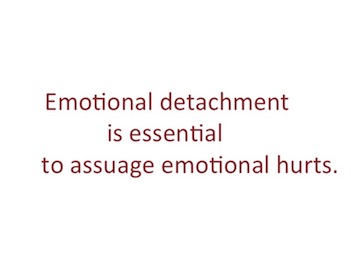
  • Forgive and forget. Forgiveness is the first step to self-healing.Emotional detachment

It is very painful to detach, I know. That is why probably, time is given the greatest credit but in reality, only self-efforts have the healing power.

Try the following tips:

 Talk to yourself: Self- talking is a very powerful tool in our hands. Let the talk go on and on, don’t try to give it a direction. Let the positive and negative thoughts flow on. When they exhaust themselves, then sift through your thoughts and pick up the positive ones to convince yourself that it is not your fault.

It is just a phase: Accept that you are just going through a bad phase. Everybody has to. You don’t have any control over the circumstances but you can control the damage, which the present situation might do to your mental and emotional health.

Keep yourself busy: If you have work, bury yourself in that. It will keep you away from the depressive thoughts for a while. In case you don’t have a regular routine to keep yourself busy, read a good book, visit a friend, go and meet somebody whose company gives you relief and comfort.

Share your thoughts: Don’t conceal emotional wounds. When you speak out your mind, half of the burden wears off. You can discuss your anxieties and fears with a person you trust, a friend or your mother or sister, whosoever you are comfortable with. It gives immense relief and you will feel lighter.

Cry your heart out: As you share your feelings, let the tears flow. They bring about catharsis and have an amazing healing power. The pain of your heart will melt away for the time being. Let all the thoughts of regret, guilt and forgiveness visit you again and again and let them flow away.

Pour your heart out: Write down all your thoughts, the remorse and the censure and your answers to all the questions that are troubling you. It will give you a strange self- satisfaction and self-healing.

Listen to good music: Good music is a great healing balm; it takes us out of our situation and provides a soothing touch to our heart and soul. “For me, singing sad songs often has a way of healing a situation. It gets the hurt out in the open into the light, out of the darkness.” – Reba McEntire

Have faith in yourself. Self- therapy requires great determination to push aside your anguish and have immense faith in your efforts.

Can hurts ever be forgotten?

We try to deny them in our mind. We tell ourselves that they don’t matter to us but emotional wounds get deeper if we don’t acknowledge them.

Thank you for reading this. Please share your valuable reflections, as they are much appreciated.

If you have liked this post, please share it at your favorite social networks.

Balroop Singh.


Gratitude and Gifts

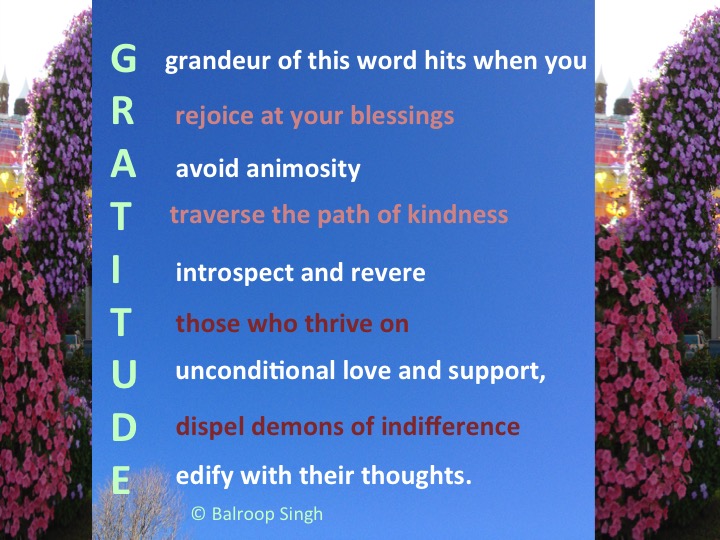
Gratitude

                                                Inundated by friendly mail
                                                 I sat, staring at the gale
                                     That whooshed through your words
                                            It empowered my thoughts
                                             And impelled me to soar

                                        Its time to express my gratitude
                                        For the inspiration, the poetry,
                                          The reflections you shared
                                      Even those who just clicked ‘like’
                                        Filled my heart with delight.

                                               As the curtain falls
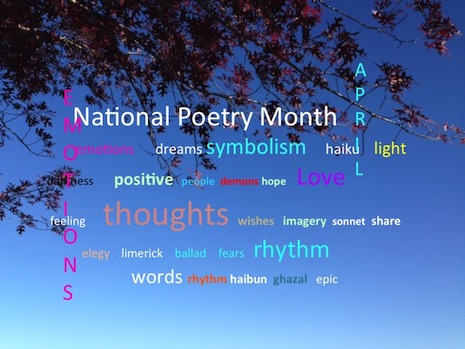
                                         On National Poetry Month
                                     I gift two eBooks, as promised
                                     To those who spoke in verses
                                   While sharing their deliberations

                                            Only a few ventured
                                         Making my decision easy
                                 My gifts go to Miriam and Pamela
                                  Pam surprised me with her knack
                                    Of creating magic on the track.
© Balroop Singh

Winners please check your email or twitter message box for claiming your gift.

Thank you for your support and contributions, much appreciated.

If you have liked this poem, please share it at your favorite social networks.

Grief, Struggle And Fame Are Interlinked #NationalPoetryMonth

Grief_Poem

Many of our favorite poets who inspire us, had to battle with life and its miseries. I have compiled some interesting and amazing facts from their lives to reiterate the facts that success doesn’t come on a platter; grief transcends all boundaries and the icy finger of death may squeeze all your dreams.

 Robert Frost sold his first poem “My Butterfly, An Elegy, to the New York Independent for $15. He was an extremely successful poet but his life was full of sorrow and suffering. His father died of tuberculosis when he was just 11 years old, leaving the family with just eight dollars. Frost’s mother died of cancer in 1900. His younger sister Jeanie died in a mental hospital, where she struggled with her mental illness for nine years. Mental illness apparently ran in Frost’s family, as both he and his mother suffered from depression and his daughter too was committed to a mental hospital in 1947.

John Keats, an English Romantic poet who is known for his brilliant poetry, vivid imagery and sensuous appeal died from tuberculosis at the age of 25. He received fame only after his death. His poems were not received well by critics during his lifetime; his reputation grew after his death.

S.T. Coleridge had bipolar disorder, which had not been defined during his lifetime. Throughout his adult life Coleridge had crippling bouts of anxiety and depression was treated for these conditions with laudanum, which fostered a lifelong opium addiction.

He is best known for his long poems, The Rime of the Ancient Mariner, Christabel and Kubla Khan, some of which were written under the influence of opium. He has given the English language the famous metaphor of “an albatross around one’s neck”, the quotation of “water, water everywhere, nor any drop to drink” and the phrase “a sadder and a wiser man.”

Walt Whitman, one of the most influential poets in the American canon, often called “the father of free verse” was very controversial in his time, particularly for his poetry collection ‘Leaves Of Grass,’ which was described as obscene for its overt sexuality.

Maya Angelou, best known for ‘I know Why the Caged Bird Sings’ became a poet and writer after a series of occupations as a young adult, including fry cook, sex worker, nightclub dancer and performer, cast member of the opera ‘Porgy and Bess’ and journalist in Egypt and Ghana during the decolonization of Africa.

When Angelou was three and her brother four, their parents’ “calamitous marriage” ended, and their father sent them to Stamps, Arkansas, alone by train, to live with their paternal grandmother. She was sexually assaulted by her mother’s boy friend when she was eight. It was her tumultuous life that molded her into a multi-faceted personality.

Mirza Ghalib, the last great poet of the Mughal Era, is considered to be one of the most famous and influential poets of the Urdu language but fame came to him posthumously. He started composing poetry at the age of 11. His verses eloquently expressed philosophy, the travails and mysteries of life.

Kahlil Gibran, a Lebanese American writer, a poet and a visual artist is the third best-selling poet of all time, behind Shakespeare and Laozi. Due to his family’s poverty, Gibran received no formal schooling during his youth in Lebanon. Gibran’s father was imprisoned for embezzlement and his family’s property was confiscated by the authorities. It was only when his mother took him to New York that he could attend school.

Emily Dickinson, a prolific poet lived much of her life in reclusive isolation. Considered to be an eccentric by locals, she developed a noted penchant for white clothing and became known for her reluctance to greet guests or, later in life, to even leave her bedroom. Dickinson’s poems are unique for the era in which she wrote; they contain short lines, typically lack titles, and often use slant rhyme as well as unconventional capitalization and punctuation.

For a poet of his stature, T.S.Eliot produced a relatively small number of poems. He was aware of this even early in his career. He wrote to J.H. Woods, one of his former Harvard professors, “My reputation in London is built upon one small volume of verse, and is kept up by printing two or three more poems in a year.”

Rudyard Kipling was born in Mumbai. (India) His parents had been so much moved by the beauty of the Rudyard Lake in Rudyard Staffordshire, (England) that when their first child was born they named him after it. In a 1995 BBC opinion poll, his poem ‘If’ was voted the UK’s favorite poem.

A 13th-century Persian poet, Rumi’s influence transcends national borders and ethnic divisions. Rumi has been described as the “most popular poet”and the “best selling poet” in the United States.

Source: Wikipedia

Compiled by Balroop Singh

Thank you for extending your support during the National Poetry Month by sharing your poems and reflections. Next post will announce the two winners of the gift that I had promised in the beginning of this month.

If you have liked this post, please share it at your favorite social networks.

Symbolism And Imagery In Poetry #NationalPoetryMonth

Symbolism and words
Poetry banks heavily on literary devices to make a mark on the reader’s mind. A poem that doesn’t touch the heart loses its appeal, which is enhanced with imagery and symbols.
Symbolism:
“Symbolism is the art of using an object or a word to represent an abstract idea. An action, person, place, word, or object can all have a symbolic meaning.”

Poets have used ‘Sun’ as a symbol for light and hope. Even a setting sun is glorified as it leaves with the promise of rising next day with new possibilities to explore.

There can be no better example than the following lines from ‘Auguries of Innocence’ by William Blake, loaded with symbols:

“To see a World in a Grain of Sand,
And a Heaven in a Wild Flower,
Hold Infinity in the palm of your hand,
And Eternity in an hour”

I think after the simple example of sun, you  can spot the symbols in the above lines. When the poet uses ‘world’ for a grain of sand, he wants you to extend your imagination to its wilder limits and by seeing ‘heaven’ in a wild flower, he wants to convey the elation that one could feel at the sight of natural beauty.

Look at the following poem, composed by my blogger friend Miriam, in which symbolism stands out in perfect harmony with her thoughts:
Thanks to Miriam for sharing her poem.

SOARINGLY

Two herons fly
love and life in harmony
wisdom and purity,
Wingtip to wingtip they soar,

Perfection;
Thus to fly, what would we see below,
on our planet of beauty and wealth?
marred by rivers of sadness,
of people dispossessed, broken;

What blessing would it be,
so to float, in unity above;
unrestricted.
Above strife and savagery.

The herons glide down,
gracefully land;
among the reeds by the lake.
Fishing, resting,
Meeting their tribe.

Are they simply like us?
a different embodiment,
With advanced spirituality.
© miriam ivarson

Herons are used as symbols in the above poem to convey a profound idea of harmony and unity that human beings crave for.

Imagery:
“The mental pictures created by a piece of writing: “The imagery of “The Waste Land”: (crumbling towers, dried up wells, toppled tombstones) conveys the author’s sense
of a civilization in decay.”

Imagery creates mental pictures and we can visualise the scene through the words. When William Wordsworth says: ‘I wandered lonely as a cloud That floats on high o’er Vales and Hills’… he carries us along, we immediately get transported to an open area and a picture of sky opens before us.
Imagery stirs our senses.

Types of imagery

Visual imagery appeals to our eyes and is most commonly used in poetry. In the following lines, Robert Frost has mixed visual and auditory imagery to convey the thoughts of traveller’s horse and remind him that the weather was too bad to stop in the middle of the woods:

“He gives his harness bells a shake
To ask if there is some mistake.
The only other sound’s the sweep
Of easy wind and downy flake.”
– Stopping by Woods on a Snowy Evening by Robert Frost

The following lines exemplify auditory imagery:
“But the fact is I was napping, and so gently you came rapping,
And so faintly you came tapping, tapping at my chamber door,
That I scarce was sure I heard you”—here I opened wide the door;—
Darkness there and nothing more.”
– The Raven by Edgar Allan Poe

The following lines show organic imagery, bringing out the emotions and hunger of the poet:
“If each day a flower
climbs up to your lips to seek me,
ah my love, ah my own,
in me all that fire is repeated,
in me nothing is extinguished or forgotten,
If You Forget me.”
– Pablo Neruda

Figures of speech like metaphor, simile, personification, alliteration and assonance are mixed with imagery to enhance the beauty of poetic language.

One of my blogger friends, Radhika, who considers herself “an infant poet” who started her “odyssey with words,” with her blog has shared a poem, which uses the most powerful images like ‘smoky conversations’ and ‘frozen whispers.’

WINTER12a697cba0387228f381470e1466afd4

The air pregnant with the northern winds
embraces the earth with a shivering hug
kisses the dull morning sky with a misty spell
under the blanket of the opaque fog.
A witness to this winter morning ritual
the coy and shy flowers smile tenderly
the gentle rays of the sun peeking
through the stale grey clouds
creating gleaming patterns of mosaic
on the landscape painted in a monochrome.
Buried greenery, frosted pathways
lashing winds, chattering teeth,
smoky conversations and frozen whispers,
It’s time to enjoy the seasonal beauty
that winter brings along!
© Radhika

I would be gifting two ebooks of ‘Sublime Shadows Of Life‘, my debut book to those two readers who write the most poetic answer to all the posts I publish this month – #NationalPoetryMonth. Happy writing!

You might also like: How to Understand Poetry

How Poetry Makes us Positive Minded

Thank you for reading this. Please share your valuable reflections, as they are much appreciated.

If you have liked this post, please share it at your favorite social networks.

Balroop Singh.