Grief, Struggle And Fame Are Interlinked #NationalPoetryMonth

Grief_Poem

Many of our favorite poets who inspire us, had to battle with life and its miseries. I have compiled some interesting and amazing facts from their lives to reiterate the facts that success doesn’t come on a platter; grief transcends all boundaries and the icy finger of death may squeeze all your dreams.

 Robert Frost sold his first poem “My Butterfly, An Elegy, to the New York Independent for $15. He was an extremely successful poet but his life was full of sorrow and suffering. His father died of tuberculosis when he was just 11 years old, leaving the family with just eight dollars. Frost’s mother died of cancer in 1900. His younger sister Jeanie died in a mental hospital, where she struggled with her mental illness for nine years. Mental illness apparently ran in Frost’s family, as both he and his mother suffered from depression and his daughter too was committed to a mental hospital in 1947.

John Keats, an English Romantic poet who is known for his brilliant poetry, vivid imagery and sensuous appeal died from tuberculosis at the age of 25. He received fame only after his death. His poems were not received well by critics during his lifetime; his reputation grew after his death.

S.T. Coleridge had bipolar disorder, which had not been defined during his lifetime. Throughout his adult life Coleridge had crippling bouts of anxiety and depression was treated for these conditions with laudanum, which fostered a lifelong opium addiction.

He is best known for his long poems, The Rime of the Ancient Mariner, Christabel and Kubla Khan, some of which were written under the influence of opium. He has given the English language the famous metaphor of “an albatross around one’s neck”, the quotation of “water, water everywhere, nor any drop to drink” and the phrase “a sadder and a wiser man.”

Walt Whitman, one of the most influential poets in the American canon, often called “the father of free verse” was very controversial in his time, particularly for his poetry collection ‘Leaves Of Grass,’ which was described as obscene for its overt sexuality.

Maya Angelou, best known for ‘I know Why the Caged Bird Sings’ became a poet and writer after a series of occupations as a young adult, including fry cook, sex worker, nightclub dancer and performer, cast member of the opera ‘Porgy and Bess’ and journalist in Egypt and Ghana during the decolonization of Africa.

When Angelou was three and her brother four, their parents’ “calamitous marriage” ended, and their father sent them to Stamps, Arkansas, alone by train, to live with their paternal grandmother. She was sexually assaulted by her mother’s boy friend when she was eight. It was her tumultuous life that molded her into a multi-faceted personality.

Mirza Ghalib, the last great poet of the Mughal Era, is considered to be one of the most famous and influential poets of the Urdu language but fame came to him posthumously. He started composing poetry at the age of 11. His verses eloquently expressed philosophy, the travails and mysteries of life.

Kahlil Gibran, a Lebanese American writer, a poet and a visual artist is the third best-selling poet of all time, behind Shakespeare and Laozi. Due to his family’s poverty, Gibran received no formal schooling during his youth in Lebanon. Gibran’s father was imprisoned for embezzlement and his family’s property was confiscated by the authorities. It was only when his mother took him to New York that he could attend school.

Emily Dickinson, a prolific poet lived much of her life in reclusive isolation. Considered to be an eccentric by locals, she developed a noted penchant for white clothing and became known for her reluctance to greet guests or, later in life, to even leave her bedroom. Dickinson’s poems are unique for the era in which she wrote; they contain short lines, typically lack titles, and often use slant rhyme as well as unconventional capitalization and punctuation.

For a poet of his stature, T.S.Eliot produced a relatively small number of poems. He was aware of this even early in his career. He wrote to J.H. Woods, one of his former Harvard professors, “My reputation in London is built upon one small volume of verse, and is kept up by printing two or three more poems in a year.”

Rudyard Kipling was born in Mumbai. (India) His parents had been so much moved by the beauty of the Rudyard Lake in Rudyard Staffordshire, (England) that when their first child was born they named him after it. In a 1995 BBC opinion poll, his poem ‘If’ was voted the UK’s favorite poem.

A 13th-century Persian poet, Rumi’s influence transcends national borders and ethnic divisions. Rumi has been described as the “most popular poet”and the “best selling poet” in the United States.

Source: Wikipedia

Compiled by Balroop Singh

Thank you for extending your support during the National Poetry Month by sharing your poems and reflections. Next post will announce the two winners of the gift that I had promised in the beginning of this month.

If you have liked this post, please share it at your favorite social networks.
When Grief Transports You Back…

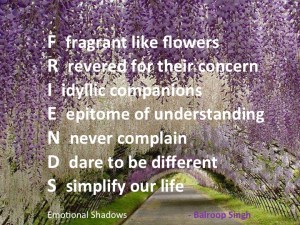
friendsLast week I received shocking news, which transported me back into time…those pleasant days of sitting for hours in the company of friends, those carefree moments that seemed to suggest life is blissful. We basked in its glory, oblivious of the fact that we would go our own way, get busy with the nuances of life only to meet occasionally and that too if we made special efforts to synchronize our visits to our home city.

Time is ephemeral, but we keep drifting back into it whenever it exhibits its tyranny!

This tyrant snatched away those insouciant moments we still treasure. Ironically… it brings back those whiffs of friendly fragrance more at such times of bereavement.

Happier times pass by complacently, with the thoughts that all is well and we have all the time in the world to meet.

Could we ever imagine that a day will come when we would be far away from each other, yearning to be together in the grief of one of us?

Could we ever reflect that we would be placed thousands of miles away and the word ‘friendship’ would stand before us in a questioning mode?

Could we ever think that one of our most effervescent and vivacious friends would be the first one to face the biggest setback of life…losing her husband and that too at such a stage when life starts afresh?

I always thought that I have become impervious to setbacks, having the experience of facing them since childhood but each one brings new emotions and memories. This one jolted me out of my illusionary world of thinking ‘everyone has to go and so must I.’

I often say I am ready to go, unmindful of the sentiments of my dear ones. I preach selflessness but in the process forget certain emotions that are vital to heart despite detachment. Today these emotions are hitting me hard from a new angle. They remind me that detachment is a mere word…a delusion to keep us occupied to deal with the struggles and realities of this world.

friends

Real detachment is painful and the laceration never heals as it is eternal…it is like amputating one part of the body.

Recently I came across an interesting perspective about time – “Time does not heal, it just teaches us how to live with the pain.” This outlook appealed to me and as I look back, I nod to myself how true it is as time has blurred my agony and hurts and I have learnt to live with them.

I know my wishful thinking can never put us in the same boat of blissful friendship we shared but we can provide solace with our words. We cannot bridge the distances but we can be with each other in spirit.

As I grieve over the loss and loneliness of my dear friend, the words of a famous poet come to my mind: “If moments were birds, I could have caged them, nurtured them with care, fed them with pearls and kept them close to my heart…”

Moments do get entrapped in our hearts and we can revisit them through our “inward eye.”

“A friend is what the heart needs all the time.” Henry Van Dyke

‘The greatest gift of life is friendship’…Have you received it?

Thank you for reading this amalgamation of emotions. Please add your valuable reflections, they are much appreciated.

If you have liked this real story, please share it at your favorite social networks.

Balroop Singh.


Self-judgment Is Equally Detrimental

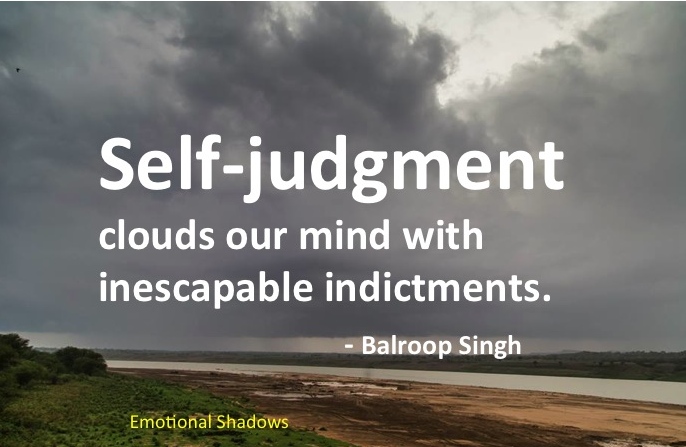
Self-judgment

I am sure nobody likes to be judged but what about our own judgment, which is continuous and constant?

Did I hurt him/her? Did I say something offending? Did I shirk my responsibility? Where did I go wrong?

Am I right in…there are thousands of such questions, which keep cropping up in our minds every day. We may call it self-reflection but it is self-judgment too.

The difference is just this – the former is positive and the latter is negative.

We all know that negative thoughts are overpowering and intensely pernicious. Yet we let them dwell in our minds.

They are like those moments of pain that never go. No! They are not the old ones. New keep cropping up.

Some moments, which are too personal, too close…so precious that you can’t even share them. You can’t let them go. You have to grieve over them. You make peace with that pain because it is not directly yours, not within your reach yet it is connected with you…in the form of a near one, a very dear person who considers you your confidant.

Can that pain be betrayed? Can you detach from such a situation?

Can you blame yourself?

I have written about detachment, about letting go to move ahead, about the ‘Valley Of Happiness’ that is so easy to imagine but when you try to live in that valley, somebody enters to remind that life never fails to bring up new turbulences even if you try to conquer it’s endeavors.

Those moments of elusive sleep with mind drifting into the forgotten realms return. You wonder where your promise of keeping grief at bay has vanished.

You think for hours and then remind yourself that the only way is to dismiss those despondent thoughts.

When we think for hours, searching for our own role in the whole scenario – that is self-judgment.

When we blame ourselves for something we didn’t do intentionally – that is self-judgment.

When we wallow in the grief of a near or dear one – who doesn’t possess the confidence to move on, searching our own role in the situation or failure to help, that is self-judgment.

You try to respond to a sad story in a positive manner but that lump in the throat wouldn’t let the words flow out, you want to scream yet the voice seems to fail you, you feel throttled, tears well up in your eyes but you try to hold them to show your courage and all these emotions get wedged between the struggle to grieve and let go.

People consider you a sentimental fool!

All that tall talk… ‘Count your blessings’ seems hollow at such a time.

Despite all the feelings of helplessness and anguish, we have to hold the strings of positivity to leap out of those dumps.Self-judgment quote

There is no other way. The choice is ours. Keep lying low and wallow in self-pity or grieve and be done with it.

Self-judgment makes us doubt our own intentions.

It shakes our confidence.

It lowers our self-esteem.

It pulls us back into the dumps of depression.

THE ONLY CHOICE:

Train your mind: If you tend to hold yourself responsible for the misfortunes of others who are dear to your heart, you need to train your mind. Like any other training, it would take time. It would take more time than getting a mechanical training because emotions are supple, attachments are deep-rooted and enlightenment may require a full life.

Remind yourself: It is not your problem. You can’t mitigate the pain of others. You can’t change their circumstances. You can only empathize. Don’t drown yourself in their sorrow.

Give positive support: Avoid criticism; it never helps. All we need is reassurance that we are on the right path, that we are putting in our best efforts and our love for those we value would never wane.

Do you judge yourself? Do you hold yourself responsible for the misfortunes of others? I would love to hear your views.

Thank you for reading this. Please add your valuable reflections, they are much appreciated.

If you have liked this article, please share it at your favorite social networks.

Balroop Singh.


Is It Deluge Of Destiny Or Just Hatred?

Deluge of destiny

I know grief is not individualistic
I know it pervades all around
I know it is self- healer
I know it unfolds the truth of transience.

I don’t want to wish it away
I want to let it penetrate my skin
Let the flames of its fire
Steel my bones, fortify my spirit.

I don’t want to hold the flood of tears
I know they will drown the ash
The hurt, the despair, the emptiness
I know, deeper love causes greater grief.

I want to return to love and laughter
I want to open my windows to the sky
The anguish, the loss buried inside
Will it ever let me do that?

Every morning I wake up with your thoughts
Hoping for the dawn that erases bias
Wishing to feel the silence of guns
Yearning for peaceful co-existence

I live with the hope of change
To heal the aggrieved hearts
My hands may be empty
But they can handle the deluge of destiny.

© Balroop Singh
All rights reserved.

Each life is precious, each tear carries a deluge.

You can click on Sublime Shadows of Life by Balroop Singh to read more such poems.

If you have liked this poem, please share it at your favorite social networks.

Thank you for your support. Please add your valuable reflections, they are much appreciated.

The Emotional Aspect Of Grief, Which Later Became My Friend!

Grief

Grief…I have written a lot of poetry about this word, which ceased to be a word for me long back and became an ever-encompassing emotion, just like the threatening dark clouds, which refuse to break away without torrential rain.

I know this emotion is not individualistic. I know it is all pervading and agonizing but when it starts defining life for us at a very young age, it becomes a part of our personality.

That is how it assaulted me, devoid of any compassion with killer instinct to annihilate my existence.

I had to deal with it single-handed, finding excuses to hide away from it, putting up a brave front, denying its existence and even shoving it into the obscure corners of my mind.

We can do so when we are very young, burying our memories with the hope that they will remain repressed. Dwelling in the world of denial we move on, pursuing our dreams and basking in their glory.

Forgetting that no glory lasts forever. Oblivious of the reality that grief is an incessant stream that flows into our life time and again and brings all those boulders back, which we had discarded in the hope of never meeting again.

It is like an ember that keeps glowing in one corner of our heart, which keeps reminding that it is real, it is persistent, it cannot die.

How can you expect a child to grieve? A child who doesn’t even know this word, who is suddenly thrown into the sea and expected to swim!

How can you tell a child to shed tears and empathize with those who want to glorify grief?

‘How dare you smile or laugh’…people remind us and compel us to keep the grief alive in our heart.

I can recollect a feeling of emptiness, of loneliness, of guilt encompassing me, shrieking…keep that emotion alive. A reprimand arising out of my heart…dare you not abandon it!

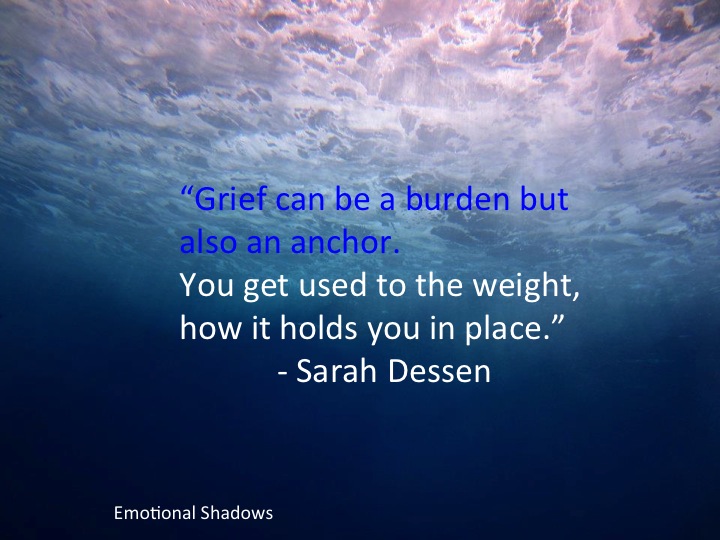
Such is the way of the world or that is what I experienced. Moments of joy were snatched away not just by the dead, who left me behind but even those who were alive because they chose to live in sorrow.Grief quote

Grief is one emotion that can never be suppressed… I learnt this lesson in the prime of my adolescence; it is better to accept it, embrace it and conduct a meaningful dialogue with it.

Give it some time to let it percolate, assess your strength, build it further and emerge emotionally resilient. Only grief can do it. It is only in misery that we learn to become understanding. Our vibes of sensitivity become more functional. We become resistant to judgments.

We learn to live with it.

“Grief is like the ocean; it comes on waves ebbing and flowing. Sometimes the water is calm and sometimes it is overwhelming. All we can do is learn to swim.” – Vicki Harrison

After all the tears and heartbreaking moments of anguish, grief starts diluting itself and steps out. We just have to open the doors and windows to let it ease. Now it re-enters in a new form if we are ready to accept him like a friend.

When I befriended grief it started patting on my back, it sat with me to reassure that it would welcome joy. I was astounded that it too loved to break free. Now both of us enjoy freedom, soar with each other, laughter accompanies us and we have vanquished negative thoughts.

We pour our concerns and tears into poetry, which is all-absorbing and provides us with somber solace.

Grief is our best friend:

It acquaints us with our inner self.

It makes us ponder to understand its nuances.

It makes us wiser and more tolerant.

It reinforces our faith and strength.

It ennobles us.

It introduces us to joy, which lies in little, fleeting moments.

Have you found a friend in grief by accepting it? Do you like this new relationship? I would love to hear your views.

The above extract, adapted from my next book, which is in initial stages, may seem gloomy and out of place but grief is one word that surely touches our lives with its cold hand, at some stage of life.

If you have liked this article, please share it at your favorite social networks.

Thank you for your support. Please add your valuable comments, they are much appreciated.

Balroop Singh.