
How To Deal With Insensitive People

Insensitive People

Insensitive people are all around us in the form of friends, family members, bosses and masked well-wishers. They spread their negative energy around us with their desires, diktats and decrees.

I have already written why people are insensitive, which is easier to understand than dealing with their behavior.

Often we get weary of the environment such people create and try to shun them yet we have to face them if they happen to be around us in the form of our family members. If they can’t be avoided then we must figure out the ways to deal with them.

My immediate boss was quite insensitive and judgmental. Most of my colleagues would try to please her by nodding their heads to whatever she said or expected. I could never be herded like cattle and so was always the target of her wrath.

I have had an early introduction to insensitivity, which endowed me with some capability to face such people.

Here are some ways to deal with them…

Understand them:

It is very easy to condemn others and arrive at our own conclusions about the way people behave. We never give a thought to why they do so. We feel it is not our problem!

How people treat you is all about them…and their personality, which reveals their real self in a subtle manner. You have to be intuitive enough to pick up those vibrations.

People react to your personality, potential and work according to their own perception, capability and emotional intelligence.

When people are rude, negative emotions dominate their behavior.

  • They could be anguished by their own frustrations
  • They could be struggling with their own problems
  • Somebody could have instigated them

When they are disrespectful

  • They could be biased
  • They could have been raised like that
  • They consider themselves self-righteous
  • They could be doing it out of spite

When they are indifferent

  • They can’t think beyond their own selves
  • They consider emotions to be pointless
  • They could be weak-minded

When they are disloyal

  • They are guided by their own insecurities
  • They could be self-centered
  • Financial instability cripples their thoughts

If we try to understand their circumstances, we may develop empathy for such people.

Easier said than done? I agree! But if your spouse happens to be insensitive to your love and concern, if he/she doesn’t acknowledge what all you do to make the home a happy place, how much effort goes in bearing insensitivity, you can’t just walk out of his/her life.

You have to devise ways to deal with insensitivity.

Convey your hurts, talk to them:

I would not like to say that it is easy. Only a patient and understanding person can do so as a lot of energy and emotions are involved in talking to such a person who can’t see logic. Each time you try to explain your view, they tune off as they live in their own world.

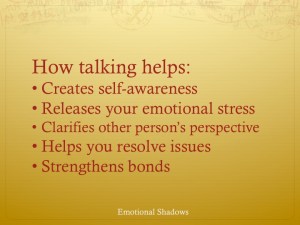
They have never been taught to respect the opinion of others. They fail to see beyond their own hurts, which appear to be mammoth. It can be emotionally draining but if you want to keep them in your lives, keep the channel of communication open.Talking helps
They would try to duck your questions.

They would prefer to remain silent.

They could even lie to avoid any discussion.

Why? Because they don’t want to expose their weaknesses. Actually such people are very weak at heart. Kindness doesn’t reach them…probably they have never seen it and feel confused.

I wouldn’t say you should give up your own kindness. This is a testing time but how far can you push your limits and let the other person cross your boundaries is what matters.

A reminder – Never accept emotional abuse. Self-love and self-esteem should never be trespassed while dealing with such persons.

Love and kindness doesn’t flow naturally, it has to be nurtured. If the other person doesn’t respond well, if strife is all that is around you, keep your thoughts positive. Positivity can be miraculous but you are the best judge to decide whether it is the time to step away.

Learn to take your own decisions. Too much dependence and too much goodness can be frustrating. Learn to strike a balance between love and servitude.

Sometimes give them back:

Use strong words to convey what you have been saying softly. Remind them how much you have done to boost their respect. Sometimes they understand the language of reprimand better than modesty.

If they withdraw into their shell, challenge them out. Tell them to convey their grievances openly. This step may reveal the reasons of their insensitivity.

I am sure you would emerge emotionally stronger, resilient and wise. The best lessons are learnt in the furnace of living through challenging situations.

Do you know any such person who is insensitive? Have you ever experienced the stress of dealing with such people? I would love to hear your views.

Thank you for reading this. Please share your valuable reflections.

If you have liked this article, please share it at your favorite social networks.

Balroop Singh.


The Room…A Cherished Memory

That dark dusty room, always closed
With no chinks to peep inside
Children of the house often conspired
To enter, to explore… but how?

Everyday they made new plansold-world-rustic-wooden-door-with-bolts-and-padlock-399x600
Waited patiently to steal the keys
What would be the right time?
To give shape to their adventure!

Would it ever be possible?
With grandma keeping a close eye,
Supervising all the time
All the happenings of the day.

The room was right in the middle
Difficult to sneak in
Even during long afternoons
Or late at night which was scary!

Little Lovely had a plan
To enter one Sunday
But who would steal the key
From that dreaded drawer!

No child had an access to that drawer
None of them had ever dared
To defy the orders of the house
To keep away from the keys!

Who would listen to those orders?
When the promises of exploring
Guided the dreams of each other
When outshining was the sole aim!

With key already in her pocket
Little Lovely had already accomplished
The first step and proved
She was the smartest of the bunch!

The day was not far
The day all would be busy
With the celebrations of Sonu’s birthday
That was the planned day!

Sonu was told to keep company
Since he was the apple of their eye
The family would hardly notice
The pranks of missing children.

Curiosity drove Sonu away
From the venue of preparations.
Grandma couldn’t contain her worry
She alerted everyone!

The dark room was already open
All the children busy
Engrossed in their long awaited adventure
They were quite fearless!

All the trunks already open
All the pictures bare,
Loud voices, long discussions
Could be heard far!

Unaware of being watched
The children made plans
They needed more days to sneak,
More hours to explore!

The family elders watched amused
None of them balked
The children were given free access
To open the room everyday!
© Balroop Singh.

You can click on Sublime Shadows of Life by Balroop Singh to read more such poems.

If you have liked this poem, please share it at your favorite social networks.
Thank you for your support. Please add your valuable comments, they are much appreciated.

Image credit

9 Ways To Knock Off Arrogance


ArroganceI have already written about arrogance and how it can be harmful for us. If you haven’t read those posts and want to start from the beginning, you can click on the following links:
How Arrogance Can Harm Your Personality

Seven Secrets Of Arrogance

Why Arrogant People Don’t Have Friends

Arrogance becomes detrimental when we accept it as an essential part of our personality. Can arrogance be divested? It may be quite challenging but not impossible.

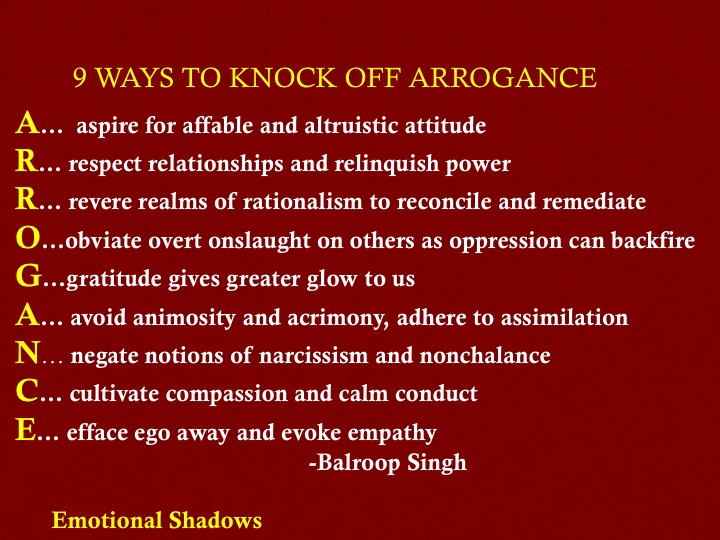
ARROGANCE…the word that conjures up negative images, the word whose connotation is often misconstrued, the word, which scares us without even touching us!

My experiences with arrogance have taught me some profound lessons. The day I tried to break it into small pieces and deal with it syllable by syllable, this is what I discovered:

We can turn it around into a positive word:

ArroganceThat is how you can revert arrogance, which is very much in your own hands.
Nobody except the arrogant can change himself or herself.

Only our inner voice can impel us towards change. When an arrogant person decides to develop humility, he or she has to overcome self-perpetuated attitude of being supreme.

It is the ego, which accentuates arrogance. When we recognize the power of self-effacement, we can accomplish a positive change in our personalities. Often we don’t make any such effort. We get so accustomed to riding the high sea that it carries us far into the realms of selfishness.

The solution lies in dropping the sails and anchoring our conceit.

Acceptance and respect are the two key words for exorcising the demonic powers of arrogance. When we start respecting others as equal human beings with same kinds of desires and emotions, when we start understanding that they too have a tender heart and get hurt by our outbursts, we begin to comprehend the subtle influence of being compassionate.

Compassion comes very slowly and only if we decide to expunge egotistical traits, which dominate arrogance.

The roots of arrogance lie elsewhere, probably in childhood or upbringing and therefore it is very essential to visit those corridors and make peace with those experiences, which are no longer relevant.

If you didn’t receive love and care in your childhood, you can’t bridge that gap now, if you crave for certain moments to return to soothe your soul, they can’t. If you were bullied and you are hiding behind arrogance to cover it up, you have to break that shell and come out.

We can embellish our personality at any stage of our life.

Read more about personality enhancement in my book.

If you have liked this article, please share it at your favorite social networks.

Thank you for reading this. Please add your valuable comments, they are much appreciated.

Balroop Singh.


Growing Intolerance In Societies – Who Is Accountable?

Intolerance

I have always been deeply disturbed by intolerance and wanted to write about it but I have always turned my face the other way, trying to avoid it, knowing well how deep-rooted this sentiment is and how less I know about it.

I have tried to understand it in my own limited arena, how it develops and gets aggravated within the families before it spills out onto the streets.

Quite early in life, I had my first encounter with this emotion albeit I had no idea that people call it intolerance and it is so widespread! With the passage of time I learnt that intolerance is the refusal to accept, appreciate and respect the views, beliefs or behavior of a person or a social group.

I also learnt that we are not born with intolerance. Children are too innocent to understand the depth of this term, which is defined for them by their parents, environment and the society in which they are raised.

So it is a learned behavior. It is most often trigged by fear or insecurity that people face in their immediate environment.

It is a universal phenomenon…in some societies it is camouflaged under empathy and help that leaders try to offer, only to exploit it for their own benefits, which could be political, religious or related to caste and color.

Mahatma Gandhi felt, “Intolerance is itself a form of violence and an obstacle to the growth of a true democratic spirit.”

We inflict this violence on each other, without caring for the emotional hurts it causes especially on young adolescents who have to deal with it in educational institutions and neighborhood.

Role of families: As a child, whenever I visited my grandmother’s home, I saw a weird form of intolerance towards the working class, who could not mingle with the landlord families, had to sit on the floor and eat in their own plates, which had to be kept separate. Feudal masters looked down upon them just because they were poor and worked in their fields.

It is quite obvious that the children of such houses would grow up with the feeling that this kind of behavior was right and that is how it got embedded in social set up. It could never be rooted out despite the best of opportunities and laws. It still exists in a veiled form because certain people refuse to accept the underprivileged and the downtrodden as their equal. They share their beliefs and opinions with their children in their own narrow-minded way and the vicious circle continues.

Intolerance

Role of groups: There are fanatics who want to underline the importance of their own caste, region, race or religion. They create such groups to highlight the superiority of their race or religion. They keep raking the age-old traditions to prove that their ancestors had rightly created the class divide. Their constant endeavor is to sow the seeds of narrow-mindedness in the impressionable minds.

The atrocities of the past, the brutalities, which were inflicted by a certain group of people, are never buried. They are kept alive by talking about them so that the posterity remembers the prejudices, so that the youth can be instigated in the name of never ending vengeance.

Education, awareness and globalization has done little in eradicating intolerance, which is much more deep-rooted than we think. It is associated with the biased views of a parent, a teacher or a leader whose influence on growing children cannot be prevented.

Role of educational institutions: Children who study in minority schools and convents are conditioned to follow a set of rules, which contribute immensely to their development. They may not be told that others are lesser than them but the way their own beliefs, principles and philosophies are drilled, do create a subtle feeling of superiority for their own group.

Some of those who are confused try to rationalize those beliefs and principles but many more are easily carried away by the radical groups and that is how fringe elements get an impetus to keep themselves active and alive to exploit the sensitive matters.

5655694025_dogs_and_diversity_xlarge
Image courtesy: http://www.sodahead.com

Intolerance is also self-perpetuated and controlling this emotion is possible:

  • Think rationally
  • Learn to control anger and jealousy
  • Be sensitive to the hurts of others
  • Nurture kindness and compassion
  • Respect the opinion of others
  • Don’t feed doubt, vengeance and outrage

Intolerance is another form of discrimination. To my mind, they are synonyms.

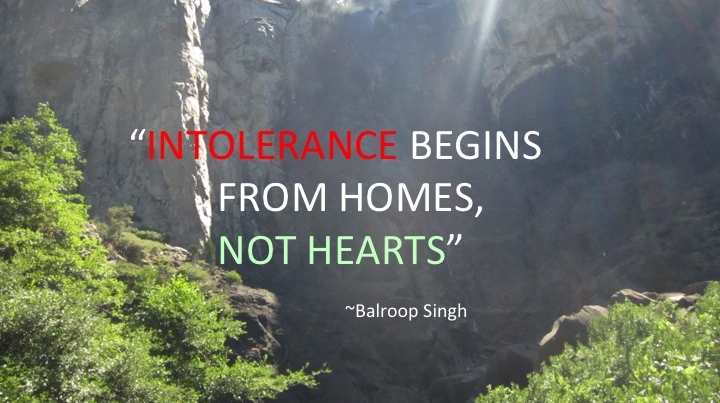
Intolerance begins from homes, not hearts.

If you have liked this article, please share it at your favorite social networks.

Thank you for your support. Please add your valuable comments, they are much appreciated.

Balroop Singh.