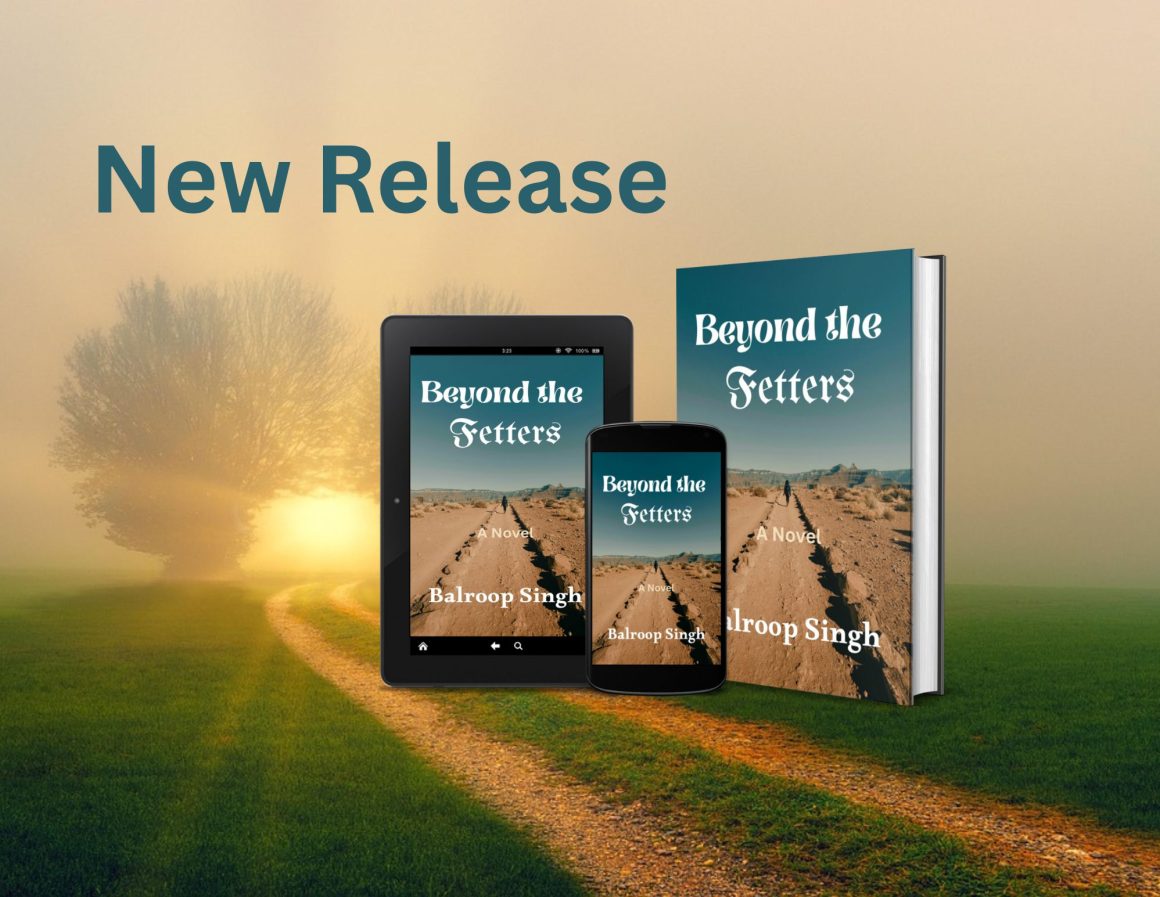
Some babies are born with invisible fetters. They may strut about in their homes with wishes of flying high, but their wings never grow, and if they do, they are clipped by the diktats of traditions. Such stories remain within the hearts of girls, as their lips are sealed by cultural compulsions.
Earthy is one such girl, but her determination to break free could never be vanquished. She yearns to grow up again, to feel the sunshine that filters through the arms of her parents, to soak in the showers of harmony, to giggle with abandon and swirl with her dreams.
The sudden, untimely demise of her father rips her whole world apart, and the little joys of childhood vanish. From emotional deluge to resilience and detachment, she treads the paths of her life, struggling to rise above the average.
Dolly’s freedom takes her away from her family, and her choices boomerang. Imperceptible fetters follow her in the garb of love that she chooses. Should we pay attention to Grandma’s wise words – “We are tied to our destiny?” ‘Beyond the Fetters’ explores the possibilities of girls looking beyond their so-called destiny.
I look forward to the support of all my readers and buddies. Thank you.
For poetry, hang out with Hues Of Hope All the posts on my blog are created by me and are protected by copyright. It is strictly prohibited to use them to train AI technologies.
Grief is like a perennial stream that flows unaffected, as the layers of glacier that sit within our hearts get thicker each moment. The tunnels of thawed emotions struggle to find a passage, which is often blocked by outside influence – by our own family members and friends. Their words of sympathy try to plug the bleeding holes, little knowing that some cracks are permanent; they can’t be darned. I’ve tried to give vent to my frozen feelings in these poems.
Shocked beyond words at the sudden demise of my husband, I found refuge in poetry. With a choked throat and numb lips, I sat shivering. Alone, unable to speak.
Tears flowed when I wrote these poems; they continued to flow when I read them again and again to check for any errors. Now they lurk around the rims of my eyes, the heaviness in the heart has not decreased; the emptiness in the pit of my stomach makes me shudder even now, after almost a year of being alive without him.
This journey through grief is now available for pre-order.
Here is the link: your book’s detail page* in the Kindle Store. A paperback will be available within two days.
Dear friends and blogger buddies, thank you for reading my poems though they’ve taken a turn into dark alleys but I promise to emerge from them, one day.
This week’s challenge invitation is to explore the world of collective animal nouns. Hop over to Colleen’s site for more details about this interesting challenge.
Fusion is the elixir of life. We seek it in every aspect of the cosmos. The magic of fusion manifests itself in the colors of dawn and dusk, in the melodies of nature, in the singing of birds, in the miniscule moments of joy, inspiring us to live in harmony with each other despite the edges that threaten to swallow us.
The poems in this collection are an amalgamation of harmonies and edges that bind us firmly. We have to wade into murky waters to measure the depth. We have to risk the heights to know our worth. Slippery snow makes us learn how to create footholds. Some songs of life dilute in the hourglass of time to erase the shadows – dark or light, all the colors play an equal role to create a fusion.
I am looking forward to your help in promoting it. Thank you for your continued support.
A special thanks to Sally Cronin for making a grand announcement of ‘Fusion’ at her esteemed site.
Today we are celebrating ‘In the Tree’s Shadow’ by D.L. Finn. Denise is my blogger buddy and a prolific writer who inspires through her fabulous stories. I am delighted to welcome her here, to talk about her latest book.
Thank you, Balroop, for having me visit today to share my latest release,In the Tree’s Shadow.
“Man on a Pier” came from a vivid dream during a power outage. The dream gave me many pictures to work from of an old man, a cage of dead fish, and a pier. I wrote it down as soon as I woke up so I wouldn’t forget it.
Captain Randall walked down the pier daily with his cage of dead fish. Sasha watched him quietly, knowing speaking to him had dire consequences.
Blurb:
A collection of short stories where dreams and nightmares coexist.
Nestled inside these pages, you’ll meet a couple in their golden years who take a trip with an unexpected detour, a boy desperate to give his brother the Christmas gift he asked for, a girl with a small glass dragon who is at the mercy of her cruel uncles, and a young mother who has a recurring dream about murder. You’ll be introduced to worlds where people get second chances and monsters might be allowed their desires, while angels and dragons try to help. Happy endings occur, but perspective can blur the line between good and evil in these twenty-seven tales. Since the stories vary between 99 and 12,000 words, whether you have only five minutes or an entire evening to settle into reading, there is something that will suit your time and taste.
Let me share my review:
‘In the Tree’s Shadow’ is a unique collection of short stories, as it offers stunning variety. Realism, fantasy and paranormal mingle into each other in this assortment that contains all flavors just like a box of chocolates. Finn’s signature style of nature in harmony with her characters and Angels waiting nearby shines throughout the book, despite the dark themes. ‘The Bonsai’ illustrates it so well. Her stories may rise above the realities of life but they speak of love, loss and kindness.
The spooky aura that she creates with her words in ‘It’s Only a Dream’ and ‘When the Lights go Out’ makes you shudder and believe that some of our darkest nightmares are real! The dream in the ‘Deadline’ is so lucid that I could feel the labored breath of Sadie on my shoulder. Such is the magic of Finn’s style! If ‘Lyrical Dragon’ is highly imaginative, ‘The Bike’ exudes real human values. If you love short stories, you must read this collection.
Excerpt:
The lanky apparition known as Captain Randall carried a long cage full of dead fish in his arms along a wooden pier. He was dressed in brown pants and a blue shirt with brass buttons. His stringy gray hair was tied back with a strip of tanned leather, and his brown boots were scuffed and worn. He set his contraption across from where I sat on the newly painted white bench.
Nothing would have happened that day if it hadn’t been for that man out jogging.
The runner in gray sweats and a shiny blue fitted shirt skidded to a stop in front of Captain Randall, who looked like any other fisherman except for his dated clothes. I jumped up to stop him, but he said, “Hi, I’m Lucas, and I’m new to the area. What’s that for?”
Captain Randall smiled, exposing a mouthful of rotten teeth as he skillfully sliced open the rotting fish. “Come see, Lucas. Follow me.” He gripped the cage and jumped into the icy waters.
I grasped Lucas’s sweaty arm, shaking my head. He grinned, pushed me away, and followed the captain into the water without hesitation.
1. I checked an item off my bucket list. A humpback whale brought her baby to see us in Alaska while we were on a boat tour.
2. I talked my husband into flying over Kauai in a helicopter. I enjoyed it—he didn’t.
Meet the Author:
D. L. Finn is an independent California local who encourages everyone to embrace their inner child. She was born and raised in the foggy Bay Area, but in 1990 she relocated with her husband, kids, dogs, and cats to Nevada City, in the Sierra foothills. She immersed herself in reading all types of books but especially loved romance, horror, and fantasy. She always treasured creating her own reality on paper. Finally, surrounded by towering pines, oaks, and cedars, her creativity was nurtured until it bloomed. Her creations include children’s books, adult fiction, a unique autobiography, and poetry. She continues on her adventure with an open invitation to all readers to join her.
Jacqui is an accomplished author and has written two series about pre-historic human beings. We know little of that time but the way Jacqui brings it to life is amazing! Her meticulous research and her ability to create memorable characters shines through her work. I have read all the books in the series and found them captivating.
Today I am going to share Natural Selection, her third book in the Dawn of Humanity series and my review of this book.
Book Summary:
In this conclusion to Lucy’s journey, she and her tribe leave their good home to rescue former-tribe members captured by the enemy. Lucy’s tribe includes a mix of species—a Canis, a Homotherium, and different iterations of early man. In this book, more join and some die, but that is the nature of prehistoric life, where survival depends on a combination of our developing intellect and our inexhaustible will to live. Each species brings unique skills to this task. Based on true events.
Set 1.8 million years ago in Africa, Lucy and her tribe struggle against the harsh reality of a world ruled by nature, where predators stalk them and a violent new species of man threatens to destroy their world. Only by changing can they prevail. If you ever wondered how earliest man survived but couldn’t get through the academic discussions, this book is for you. Prepare to see this violent and beautiful world in a way you never imagined.
Natural Selection (Dawn of Humanity – book 3) continues the story of Lucy who has a daunting task before her – to rescue past members of her tribe from Man-who-preys and continue her search for a sustainable homebase. Jacqui’s research shines through this final book in the series and many questions that may crop up in a reader’s mind are answered in the beginning of the book. There is some repetition but if you haven’t read the earlier books in the series, that could be helpful in understanding the challenges that the early dwellers of earth had to face.
It is interesting to note the development of characters and their way of dealing with immediate dangers. Their helpful nature, concern for safety, planning attitude is noteworthy and speaks about the natural instincts of mankind. At the same time dominance over the weak, hatred and the urge to keep control over captives has also been highlighted. This book gives a holistic picture of prehistoric man. Raza “furtively sliced a portion” of massive carcass underlines another aspect of man.
I liked Ahnda who could overcome the loss of his eyesight with the help of his smell. It is amazing that he could smell water ahead and could tell exactly where it was and could also hear the reverberation from trees though it took him a long time to understand the distinctions between a forest, lake, valley and plateau. If you have a curious mind and want to know how mankind evolved, ‘Dawn of Humanity’ series is perfect for you.
Excerpt
Chapter – 1
One Pack Ends, Another Begins
Africa
The Canis’ packmates were all dead, each crumpled in a smeared puddle of blood, Upright killing sticks embedded where they should never be. His body shook, but he remembered his training. The killers’ scent filled the air. If they saw him—heard him—they would come for him, too, and he must survive. He was the last of his pack.
He padded quietly through the bodies, paused at his mate, broken, eyes open, tongue out, pup under her chest, his head crushed. A moan slipped from his muzzle and spread around him. He swallowed what remained in his mouth. Without a pack, silence was his only protection. He knew to be quiet, but today, now, failed.
To his horror, a departing Upright looked back, face covered in Canis blood, meaty shreds dripping from his mouth, the body of a dead pup slung over his shoulder. The Canis sank into the brittle grass and froze. The Upright scanned the massacre, saw the Canis’ lifeless body, thought him dead like the rest of the decimated pack. Satisfied, he turned away and rushed after his departing tribe. The Canis waited until the Upright was out of sight before cautiously rising and backing away from the onslaught, eyes on the vanished predators in case they changed their minds.
And fell.
He had planned to descend into the gully behind him. Sun’s shadows were already covering it in darkness which would hide him for the night, but he had gauged his position wrong. Suddenly, earth disappeared beneath his huge paws. He tried to scrabble to solid ground, but his weight and size worked against him and he tumbled down the steep slope. The loose gravel made gripping impossible, but he dug his claws in anyway, whining once when his shoulder slammed into a rock, and again when his head bounced off a tree stump. Pain tore through his ear as flesh ripped, dangling in shreds as it slapped the ground. He kept his legs as close as possible to his body and head tucked, thankful this hill ended in a flat field, not a river.
Or a cliff.
When it finally leveled out, he scrambled to his paws, managed to ignore the white-hot spikes shrieking through his head as he spread his legs wide. Blood wafted across his muzzle. He didn’t realize it was his until the tart globs dripped down his face and plopped to the ground beneath his quaking chest. The injured animal odor, raw flesh and fresh blood, drew predators. In a pack, his mate would purge it by licking the wound. She would pronounce him Ragged-ear, the survivor.
Ragged-ear is a strong name. A good one.
He panted, tail sweeping side to side, and his indomitable spirit re-emerged.
I live.
But no one in his pack did.
Except, maybe, the female called White-streak. She often traveled alone, even when told not to. If she was away during the raid, she may have escaped. He would find her. Together, they would start over.
Ragged-ear shook, dislodging the grit and twigs from his now-grungy fur. That done, he sniffed out White-streak’s odor, discovered she had also descended here. His injuries forced him to limp and blood dripping from his tattered ear obstructed his sight. He stumbled trying to leap over a crack and fell into the fissure. Fire shot through his shoulder, exploded up his neck and down his chest. Normally, that jump was easy. He clambered up its crumbling far wall, breaking several of his yellowed claws.
All of that he ignored because it didn’t matter to his goal.
Daylight came and went as he followed White-streak, out of a forest onto dry savannah that was nothing like his homeland.
Why did she go here?
He embraced the tenderness that pulsed throughout his usually-limber body. It kept him angry and that made him vicious. He picked his way across streams stepping carefully on smooth stones, their damp surfaces slippery from the recent heavy rain, ignoring whoever hammered with a sharp rock inside his head. His thinking was fuzzy, but he didn’t slow. Survival was more important than comfort, or rest.
Ragged-ear stopped abruptly, nose up, sniffing. What had alerted him? Chest pounding, breathing shallow, he studied the forest that blocked his path, seeking anything that shouldn’t be there.
But the throbbing in his head made him miss Megantereon.
Ragged-ear padded forward, slowly, toward the first tree, leaving only the lightest of trails, the voice of Mother in his head.
Yes, your fur color matches the dry stalks, but the grass sways when you move. That gives away your location so always pay attention.
His hackles stiffened and he snarled, out of instinct, not because he saw Megantereon. Its shadowy hiding place was too dark for Ragged-ear’s still-fuzzy thinking. The She-cat should have waited for Ragged-ear to come closer, but she was hungry, or eager, or some other reason, and sprang. Her distance gave the Canis time to back pedal, protecting his soft underbelly from her attack. Ragged-ear was expert at escaping, but his stomach spasmed and he lurched to a stop with a yowl of pain. Megantereon’s next leap would land her on Ragged-ear, but to the Canis’ surprise, the She-cat staggered to a stop, and then howled.
While she had been stalking Ragged-ear, a giant Snake had been stalking her. When she prepared her death leap, Snake dropped to her back and began to wrap itself around her chest. With massive coils the size of Megantereon’s leg, trying to squirm away did no good.
Ragged-ear tried to run, but his legs buckled. Megantereon didn’t care because she now fought a rival that always won. The She-cat’s wails grew softer and then silent. Ragged-ear tasted her death as he dragged himself into a hole at the base of an old tree, as far as possible from scavengers who would be drawn to the feast.
He awoke with Sun’s light, tried to stand, but his legs again folded. Ragged-ear remained in the hole, eyes closed, curled around himself to protect his vulnerable stomach, his tail tickling his nose, comforting.
He survived the Upright’s assault because they deemed him dead. He would not allow them to be right.
Sun came and went. Ragged-ear consumed anything he could find, even eggs, offal, and long-dead carcasses his pack normally avoided. His legs improved until he could chase rats, fat round ground birds, and moles, a welcome addition to his diet. Sometimes, he vomited what he ate and swallowed it again. The day came he once again set out after what remained of his pack, his pace more sluggish than prior to the attack, but quick enough for safety.
Ragged-ear picked up the female’s scent again and tracked her to another den. He slept there for the night and repeated his hunt the next day and the next. When he couldn’t find her trace, instinct drove him and memories of the dying howls of his pack, from the adults who trusted their Alpha Ragged-ear to protect them to the whelps who didn’t understand the presence of evil in their bright world.
Everywhere he traveled, when he crossed paths with an Upright, it was their final battle.
Jacqui Murray is the author of the popular prehistoric fiction saga, Man vs. Nature which explores seminal events in man’s evolution one trilogy at a time. She is also author of the Rowe-Delamagente thrillers and Building a Midshipman , the story of her daughter’s journey from high school to United States Naval Academy. Her non-fiction includes over a hundred books on integrating tech into education, reviews as an Amazon Vine Voice, a columnist for NEA Today, and a freelance journalist on tech ed topics.








 Emotional Shadows