Grief, Struggle And Fame Are Interlinked #NationalPoetryMonth

Grief_Poem

Many of our favorite poets who inspire us, had to battle with life and its miseries. I have compiled some interesting and amazing facts from their lives to reiterate the facts that success doesn’t come on a platter; grief transcends all boundaries and the icy finger of death may squeeze all your dreams.

 Robert Frost sold his first poem “My Butterfly, An Elegy, to the New York Independent for $15. He was an extremely successful poet but his life was full of sorrow and suffering. His father died of tuberculosis when he was just 11 years old, leaving the family with just eight dollars. Frost’s mother died of cancer in 1900. His younger sister Jeanie died in a mental hospital, where she struggled with her mental illness for nine years. Mental illness apparently ran in Frost’s family, as both he and his mother suffered from depression and his daughter too was committed to a mental hospital in 1947.

John Keats, an English Romantic poet who is known for his brilliant poetry, vivid imagery and sensuous appeal died from tuberculosis at the age of 25. He received fame only after his death. His poems were not received well by critics during his lifetime; his reputation grew after his death.

S.T. Coleridge had bipolar disorder, which had not been defined during his lifetime. Throughout his adult life Coleridge had crippling bouts of anxiety and depression was treated for these conditions with laudanum, which fostered a lifelong opium addiction.

He is best known for his long poems, The Rime of the Ancient Mariner, Christabel and Kubla Khan, some of which were written under the influence of opium. He has given the English language the famous metaphor of “an albatross around one’s neck”, the quotation of “water, water everywhere, nor any drop to drink” and the phrase “a sadder and a wiser man.”

Walt Whitman, one of the most influential poets in the American canon, often called “the father of free verse” was very controversial in his time, particularly for his poetry collection ‘Leaves Of Grass,’ which was described as obscene for its overt sexuality.

Maya Angelou, best known for ‘I know Why the Caged Bird Sings’ became a poet and writer after a series of occupations as a young adult, including fry cook, sex worker, nightclub dancer and performer, cast member of the opera ‘Porgy and Bess’ and journalist in Egypt and Ghana during the decolonization of Africa.

When Angelou was three and her brother four, their parents’ “calamitous marriage” ended, and their father sent them to Stamps, Arkansas, alone by train, to live with their paternal grandmother. She was sexually assaulted by her mother’s boy friend when she was eight. It was her tumultuous life that molded her into a multi-faceted personality.

Mirza Ghalib, the last great poet of the Mughal Era, is considered to be one of the most famous and influential poets of the Urdu language but fame came to him posthumously. He started composing poetry at the age of 11. His verses eloquently expressed philosophy, the travails and mysteries of life.

Kahlil Gibran, a Lebanese American writer, a poet and a visual artist is the third best-selling poet of all time, behind Shakespeare and Laozi. Due to his family’s poverty, Gibran received no formal schooling during his youth in Lebanon. Gibran’s father was imprisoned for embezzlement and his family’s property was confiscated by the authorities. It was only when his mother took him to New York that he could attend school.

Emily Dickinson, a prolific poet lived much of her life in reclusive isolation. Considered to be an eccentric by locals, she developed a noted penchant for white clothing and became known for her reluctance to greet guests or, later in life, to even leave her bedroom. Dickinson’s poems are unique for the era in which she wrote; they contain short lines, typically lack titles, and often use slant rhyme as well as unconventional capitalization and punctuation.

For a poet of his stature, T.S.Eliot produced a relatively small number of poems. He was aware of this even early in his career. He wrote to J.H. Woods, one of his former Harvard professors, “My reputation in London is built upon one small volume of verse, and is kept up by printing two or three more poems in a year.”

Rudyard Kipling was born in Mumbai. (India) His parents had been so much moved by the beauty of the Rudyard Lake in Rudyard Staffordshire, (England) that when their first child was born they named him after it. In a 1995 BBC opinion poll, his poem ‘If’ was voted the UK’s favorite poem.

A 13th-century Persian poet, Rumi’s influence transcends national borders and ethnic divisions. Rumi has been described as the “most popular poet”and the “best selling poet” in the United States.

Source: Wikipedia

Compiled by Balroop Singh

Thank you for extending your support during the National Poetry Month by sharing your poems and reflections. Next post will announce the two winners of the gift that I had promised in the beginning of this month.

If you have liked this post, please share it at your favorite social networks.
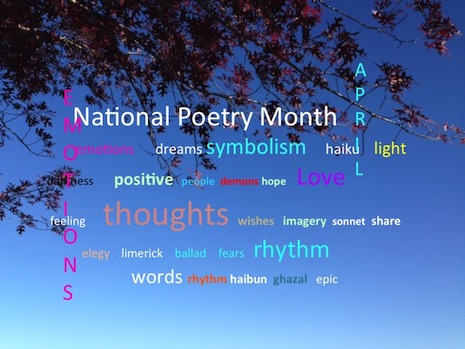
Symbolism And Imagery In Poetry #NationalPoetryMonth

Symbolism and words
Poetry banks heavily on literary devices to make a mark on the reader’s mind. A poem that doesn’t touch the heart loses its appeal, which is enhanced with imagery and symbols.
Symbolism:
“Symbolism is the art of using an object or a word to represent an abstract idea. An action, person, place, word, or object can all have a symbolic meaning.”

Poets have used ‘Sun’ as a symbol for light and hope. Even a setting sun is glorified as it leaves with the promise of rising next day with new possibilities to explore.

There can be no better example than the following lines from ‘Auguries of Innocence’ by William Blake, loaded with symbols:

“To see a World in a Grain of Sand,
And a Heaven in a Wild Flower,
Hold Infinity in the palm of your hand,
And Eternity in an hour”

I think after the simple example of sun, you  can spot the symbols in the above lines. When the poet uses ‘world’ for a grain of sand, he wants you to extend your imagination to its wilder limits and by seeing ‘heaven’ in a wild flower, he wants to convey the elation that one could feel at the sight of natural beauty.

Look at the following poem, composed by my blogger friend Miriam, in which symbolism stands out in perfect harmony with her thoughts:
Thanks to Miriam for sharing her poem.

SOARINGLY

Two herons fly
love and life in harmony
wisdom and purity,
Wingtip to wingtip they soar,

Perfection;
Thus to fly, what would we see below,
on our planet of beauty and wealth?
marred by rivers of sadness,
of people dispossessed, broken;

What blessing would it be,
so to float, in unity above;
unrestricted.
Above strife and savagery.

The herons glide down,
gracefully land;
among the reeds by the lake.
Fishing, resting,
Meeting their tribe.

Are they simply like us?
a different embodiment,
With advanced spirituality.
© miriam ivarson

Herons are used as symbols in the above poem to convey a profound idea of harmony and unity that human beings crave for.

Imagery:
“The mental pictures created by a piece of writing: “The imagery of “The Waste Land”: (crumbling towers, dried up wells, toppled tombstones) conveys the author’s sense
of a civilization in decay.”

Imagery creates mental pictures and we can visualise the scene through the words. When William Wordsworth says: ‘I wandered lonely as a cloud That floats on high o’er Vales and Hills’… he carries us along, we immediately get transported to an open area and a picture of sky opens before us.
Imagery stirs our senses.

Types of imagery

Visual imagery appeals to our eyes and is most commonly used in poetry. In the following lines, Robert Frost has mixed visual and auditory imagery to convey the thoughts of traveller’s horse and remind him that the weather was too bad to stop in the middle of the woods:

“He gives his harness bells a shake
To ask if there is some mistake.
The only other sound’s the sweep
Of easy wind and downy flake.”
Stopping by Woods on a Snowy Evening by Robert Frost

The following lines exemplify auditory imagery:
“But the fact is I was napping, and so gently you came rapping,
And so faintly you came tapping, tapping at my chamber door,
That I scarce was sure I heard you”—here I opened wide the door;—
Darkness there and nothing more.”
The Raven by Edgar Allan Poe

The following lines show organic imagery, bringing out the emotions and hunger of the poet:
“If each day a flower
climbs up to your lips to seek me,
ah my love, ah my own,
in me all that fire is repeated,
in me nothing is extinguished or forgotten,
If You Forget me.”
– Pablo Neruda

Figures of speech like metaphor, simile, personification, alliteration and assonance are mixed with imagery to enhance the beauty of poetic language.

One of my blogger friends, Radhika, who considers herself “an infant poet” who started her “odyssey with words,” with her blog has shared a poem, which uses the most powerful images like ‘smoky conversations’ and ‘frozen whispers.’

WINTER12a697cba0387228f381470e1466afd4

The air pregnant with the northern winds
embraces the earth with a shivering hug
kisses the dull morning sky with a misty spell
under the blanket of the opaque fog.
A witness to this winter morning ritual
the coy and shy flowers smile tenderly
the gentle rays of the sun peeking
through the stale grey clouds
creating gleaming patterns of mosaic
on the landscape painted in a monochrome.
Buried greenery, frosted pathways
lashing winds, chattering teeth,
smoky conversations and frozen whispers,
It’s time to enjoy the seasonal beauty
that winter brings along!
© Radhika

I would be gifting two ebooks of ‘Sublime Shadows Of Life‘, my debut book to those two readers who write the most poetic answer to all the posts I publish this month – #NationalPoetryMonth. Happy writing!

You might also like: How to Understand Poetry

How Poetry Makes us Positive Minded

Thank you for reading this. Please share your valuable reflections, as they are much appreciated.

If you have liked this post, please share it at your favorite social networks.

Balroop Singh.

How Much Of Our Poetry Is About Us?

How much Life in poetry
When I published my debut book, ‘Sublime Shadows of Life’ my excitement was at  cloud nine and I got some copies printed for friends and family and sent them, even to those friends whom I met occasionally or had not met since school days.

One of my friends who had not been in touch with me for a long time rang me up and asked: ‘Are you okay?’

I replied in affirmative and asked why was she asking.

She had a grim tone and said: ‘Is everything going well in your life?’

I laughed loudly at the tone of my fun-loving friend and asked her what was wrong with her.

She told me that she got alarmed at some of my poems, which talked about oppression and dark moments.

Though I had mentioned in the blurb “I, you, he, we and they are universal symbols, which highlight the fact that happiness is not a destination…” but who reads the introduction!

Authors draw inspiration from life and people around them and many of them agree that they do creep into their stories.

Some of my poems do give a peep into my life. I have written about an incident that moved me deeply. Some of my poems are an emotional outburst; some are inspired from the life of my friends but all of them are not about me.

This one is. I hope you would understand who this pearl is.

                                MY PEARL

Time has stood still
The storm is yet to pass
The descent of night seems eternal
Perplexed, petrified, I wait.

Wait for a new dawn
Wait for a smooth tide
Wait for that lovely flight
Which brings hope!

There was a time
When your hands held mine
The fingers so ensconced
It was hard to distinguish.

Now I hold an empty oyster
The pearl I nurtured is gone
Slipped away, leaving marks
Hard to erase, hard to forget

The purity of my pearl,
The glory of her glow,
Now brightens another world
That mitigates my woe.
© Balroop Singh, 2003

Wendy, a spiritual poet, has shared her thoughts about this topic “I have written poems about defining moments in my life. Although at that time, I may not be aware that I am writing about a moment that I would consider life defining. There have certainly been life defining moments that I did not write about at the time, but a reference to the event came much later in life as a line or stanza in a poem, as with my father’s death when I was 19.

Ritu too has written about life defining moments: “I think one of my most poignant poems about my life was the one I wrote one morning, in 10 minutes, about my journey to become a mother…” She has shared that poem with us:

FROM TWINKLE TO REALITY

Let me take you down that road,
Much travelled through eternity
The journey to become a mum,
From twinkle to reality.

F_zcVPMY_400x400
Ritu Bhathal

The plans you make at a young age,
Full of gurgles and laughter,
The horror as you realise,
What really does come after!

The fun of trying,
The monthly wait.
The disappointment,
That feeling, you hate…

The years of trying,
Full of hospitals and checks,
The medication taking you over,
You feel like total wrecks…

Then finally, the day comes
That positive is clear
The goal that you were aiming for,
Has suddenly come near.

The months of fascination,
Your changing body grows
The feeling of satisfaction
That only you can know.

Those pain-filled days, or hours
To reach the prize you sought
The feeling of satisfaction
That this little bundle brought.

I gaze at you in wonder
Are you really here?
I’m overwhelmed with happiness
And a tiny bit of fear.

Will I be able to give to you
All you want and need?
As you look at me, wide eyed
Snuggled close while you feed.

Little blessing, sent from God
My heart is filled with joy
I will do all I can for you,
My darling baby boy.

And so the cycle continues
The waits and checks again
We’re gifted with a gorgeous girl
After a little more pain.

My life is here with me right now
Some twinkles from my eyes.
But I’ll never forget those twinkles
That now, do grace the skies…

Dedicated to my wonderful children, recognising the struggles to have them, and remembering my 2 angels lighting the sky at night.
©Ritu Bhathal

Lisa has shared a poignant poem that she wrote during the difficult moments of her divorce.

PRAIRIE PRISON

Here I sit in my Prairie prison
I have known
Great joy and worse sorrow
Here I sit in my home
Longing for more…

A9dl5pvZ_400x400
Lisa Thomson

The ocean
And mountain peaks calling
I make this prison home
I look out of my window
While the prairie winds blow
Dust in my eye, pebbles in my soul

Here in my prairie prison
I long for my Ocean boy
The one and only
Yet some ties bind and clasp me
Fastening me to a make believe home
Among wheat fields

Can you blame me?
I bore my children in a prairie home
A landscape so flat
It cannot compare
To my wild, sea salt air

Maybe I’ll get there
But now
I gaze out of my prairie window
Where I found great joy
And worse sorrow.
© Lisa Thomson, Aug ‘06

I would be gifting two ebooks of Sublime Shadows Of Life, my debut book to those two readers who write the most poetic answer to all the posts I publish this month – #NationalPoetryMonth. Happy writing!

Thank you for reading this. Please share your valuable reflections, as they are much appreciated.

If you have liked this post, please share it at your favorite social networks.

Balroop Singh.

Why Do We Like Poetry?

Love for poetry

“Poetry is painting that speaks,”said Plutarch.

A painting that gets its hues from words.
Just a metaphor can evoke emotions that could not be described in a thousand words.

Poetry is liked due to its succinct style. It soars on the wings of words.
Poetry touches your deepest cords effortlessly. It develops perceptions.
It liberates us from the mundane. It gives us wings.
Due to its ambiguous nature, it can be interpreted in more than one way, depending on how the reader discerns the thoughts.

What attracts us to poetry?

There could be a myriad answers…some poets have shared them…

Ritu says:  “I love the way words flow in rhythmic ways, rhyming or not, echoing the poets thoughts, often conveying huge sentiments in limited words and lines.”

In Deborah’s opinion, “For me it just happens. In 35 seconds, there’s a poem. Love it on Twitter, but I also write book-length verse. I’m an odd duck, but I know you understand!

Robbie Cheadle “likes the flow of words and the meter of poetry. With Haiku and tanka poems, I enjoy playing around with words to make a statement with an impact.”

Miriam feels… “It rather seems that poetry grabbed hold of me. I do find the musicality, rhythm and strength of emotions attract me in a poem.

Wendy took my heart away with her profound and philosophical reflections: “Poetry gives edges, expression, and delineation to experiences that allow the reader to help define and be with their own experience that is evoked from reading the poem… Great poetry renders a visual like a painting where one can see all the splashes and colors and layers and depths or like a beautiful symphony or ensemble of music where one has the time and space to really listen to each and every instrument and the synthesis of all the textures and resonances that create the culmination of the whole journey of the musical piece.”

Radhika says: “Poetry to me, is a celebration of thoughts and language. My feelings ooze out, into which I dip the quill and ink them on paper. It is also cathartic. The deepest pain and anguish, the euphoric love, the intense moments of life, all find an outlet through words, which when woven eloquently, creates magic. I enjoy the conversation of thoughts that emanates in my mind before they paint the paper with their hues.”

I don’t remember when I developed a liking for poetry but soulful lyrics of songs always attracted me.

My real introduction to poetry occurred when I joined university and took up English as a major. Initially it was challenging to understand Robert Browning and Alfred Tennyson but the simpler poems of William Wordsworth, rich with the love of nature attracted me to poetry and my fondness kept growing.

It also depends on how well a poem is explained by our teacher and those who choose to explain even a simple simile or a metaphor are remembered fondly. I met some such gems who explained poems painstakingly.

Like my dearest friend Deborah says: The first is always special and has shared her first poem with us:

Ode to a Sunday Morn by Deborah 
[Original title. I had no idea how many lines constituted an “Ode”; still don’t, nor to I care.]
Today is made for growing
With Spring knocking at my door
The sky is dark and clouded
The rain serenely pours
The flowers gently peek
From their Winter’s hiding place
The robin he doth seek
A pine of firry lace
The rain is bringing growth
To every flower, bush, and tree
The creeks and rivers floweth
With eternal life to be
The clouds gently part
A ray of sun kisses the earth
It enlivens my heart
With the Spring’s wondrous rebirth
From a church on yonder hill
The Bells of Sabbath Ring
The world is quiet ’til
The birds begin to sing…
“I was nine years old. It was published in a 4-H magazine. I have never forgotten it, though I forget my short Twitter poems now because I write so many. The first is always special! I had been a city kid, and due to my Dad’s job we moved to the country. At first, I was afraid, but then I fell in love with nature.”
© Deborah A. Bowman

Ritu remembers that “one of my first was a poem about my brother, and how annoying he was! Apt since at 9, siblings rarely get on!”

Wendy wrote her first poem in, “I think, 6th grade (age 11 or 12, I think). It was printed in the school anthology. I wrote the poem, I believe, because it was a homework assignment to write a poem. By this age I had read quite a bit of poetry, although I suspect all of the poetry read at that point in my life had been poetry written for children. The emotion, at the time, of the poem, I believe, was silent acceptance and hope. The poem had an expression of Divinity in it-although not directly but abstractly. I think that was very reflective of where I was at in my life.”

I could not write poetry at such an early age! Even when I started writing, I didn’t share it because the poetry of John Donne, Keats, T.S. Eliot and such great poets intimidated me. My early poetry (Read here)

To be continued… Stay tuned for more!

Meanwhile please note: I would be gifting two ebooks of Sublime Shadows Of Life, my debut poetry book to those two readers who write the most poetic comments to all the posts I publish this month – #NationalPoetryMonth. Happy writing!

Thank you for reading this. Please share your valuable reflections, as they are much appreciated.

If you have liked this post, please share it at your favorite social networks.
Balroop Singh.

Book Review: Emerging From Shadows by Balroop Singh

When you have such accomplished friends as Maniparna who respond with a brilliant review of a book…you can just be as spellbound as I am right now. I am enthralled by the richness of her language, the choice of her words, the profound understanding of poetry and her in-depth analysis of my poems. Gratitude seems to be a meaningless word to thank her for her serious endeavor to interpret and bring out the subtle meaning of my poems.
I am blessed with such a blogger friend (an outstanding poet) whom I met online when I was struggling to find a foothold to survive in the blogosphere. She has kept her promise of reviewing my latest book ‘Emerging From Shadows.’

Maniparna Sengupta Majumder's avatarScattered Thoughts

emerging-from-shadows

Balroop is one of those first few bloggers I got acquainted with since the beginning of my blogging journey.  I’ve been reading her blog Emotional Shadows for quite a long time and, the depth and profoundness of her words never have failed to amaze me. So, when she offered me an e-copy of her newest publication, Emerging From Shadows, (her fifth book) a collection of poems, it was quite a pleasure.

Forty poems, composed and curated by the author herself, adorn the book. All the poems, though not related to each other, seems harmonious to me as I finished reading. As if, they are pearls of the same string and, together they exude a feeling that resonates with your mind in more than one way.

Balroop’s poems liberate the mind of the reader from darkness to light. Life, for us, is not a bed of roses. It is a roller…

View original post 474 more words