Guest author: Balroop Singh ~ Poetry And Life

Poetry tries to capture life in the most subtle manner, offering interpretations beyond the words of a poet. My guest post explores the link between life and poetry.

Sue Vincent's avatarSue Vincent's Daily Echo

Image: Sue Vincent

Poetry and life seem synonyms to me. The prism of poetry reflects life and its varied colors but the spectrum of life is much wider than poetry, which tries to capture some hues and even drifts into the darker crevices to discover those emotions that lurk on the sidelines, yearning to be embraced. Poetry digs deeper into those sensitivities; it understands the finer nuances of life and offers solace.

How well has Walt Whitman summed up the connection of poetry with life:

“We don’t read and write poetry because it’s cute. We read and write poetry because we are members of the human race. And the human race is filled with passion. So medicine, law, business, engineering… these are noble pursuits and necessary to sustain life. But poetry, beauty, romance, love… these are what we stay alive for.”  – Walt Whitman 


Most of the poets from John…

View original post 1,644 more words

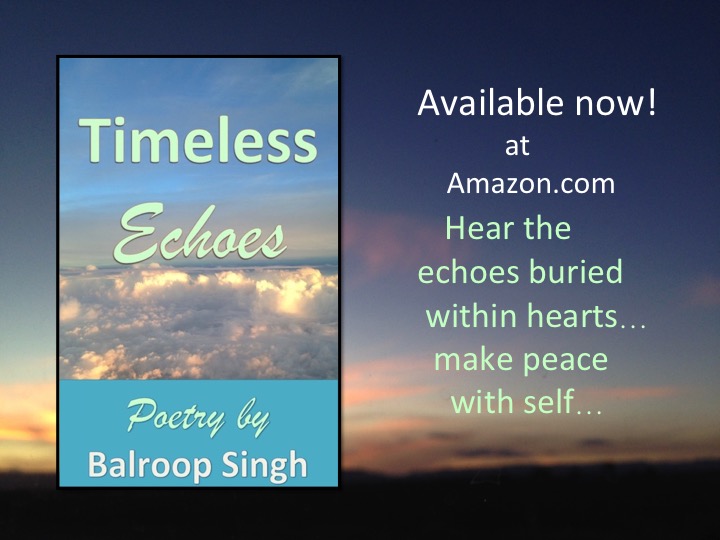
‘Timeless Echoes’ is Here!

Book cover

Timeless Echoes is just a click away now. Click on the link to download it and hear the echoes that would reverberate around you, reminding you of lost opportunities, repressed desires, cherished moments and hope that shimmers through clouds.

Here are all the links:

US UK DE FR ES IT NL JP BR CA MX AU IN

When Echoes Vibrate

Lilies in the garden spoke to me
Birds sang merrily
Clouds of gloom disintegrated
When I let these echoes vibrate

Mute watchers warbled
Fluttering fervently around me
Stirring hopeful messages
Of joy and bliss

When smoke of your love
Tried to asphyxiate me
When dreams got besieged
I flew on the wings of words

Fears receded when
Sun spread its gold
Creating a fusion of colors
Silently illuminating life.© Balroop Singh

The Editor’s Review:

Half of what we say are lies although they might be considered true, but truth with one’s self is an accepted bundle of lies except for those rare moments of self-realization. These lines right at the start of Timeless Echoes, ‘Each moment is precious, we try to cage it within our heart, where it perches in perfect rampart, embalmed by memories,’ reveal how this book is a healer, promising to lay bare the ills of the soul as it soothes, cleanses, and nurtures; instilling in us a will to learn and live without fear, and a will to not hurt others: ‘Why can’t our hearts feel the hurt we hurl at others?’

Balroop’s new book is a steadfast repudiation of those ills that we painfully hide under the covers of our flesh to present the polished exterior as truth. This magnetic collection of poems highlights our precious human lives with all their varied emotions and imposing relations: the lives often blinded by the strictures of the self-made duplicity, an excessively common phenomenon. ‘Listen to your heart, my friend. It knows you well,’ she writes.

I treasure these ‘forgetting fragile facets of love, facade of fading memories, echoes of dwindling love, is all I have now, yet love echoes refuse to subside’ believing that love echoes are soul-launched signals, ready to hug our pretenses to forge a divine assimilation because the struggle has always been with the self that we excommunicate to build up a wall, which obscures the travails plaguing the core. And finding a path to the core is the cure since there’s no villainy in the soul.

As Balroop proclaims ‘love is such a strange emotion, it gives less, it claims more…the facade of love is so delusive,’ I concur how our infirmities require urgent banishment, more pressing now than ever. And once I’ve made peace with the self, ‘the dark corridors are like meadows, they glow with my presence.’ Yes, without an iota of my own falsehoods plaguing me.
  Mahesh Nair

Thank you for your support.

Please share this post at your favorite social networks.
Balroop Singh.

Avenues of Harmony

Canopy of trees
Sue Vincent’s #writephoto

Once again our green hands
Disseminate sheltered serenity
Once again our life inspires
The love of perpetual giving

Come join the celebrations
Revel in the glory of spring melodies
Soft sounds of new leaves
Merge in the song of bluebirds

Recline in the carousel of lovebirds
Glide with the breezy fragrance
Smile with the colorful sweet peas
Feel the magical breath of spring

This green bower beckons
Accentuating avenues of harmony
Shifting seasons beseech quietly
To keep the rhythm of nature alive.
© Balroop Singh

Thanks to Sue Vincent for an inspiring Thursday photo prompt Avenue #writephoto.

You can click here for more poetry.

If you have liked this poem, please share it at your favorite social networks.
Thank you for your support. Please add your valuable reflections, they are much appreciated.

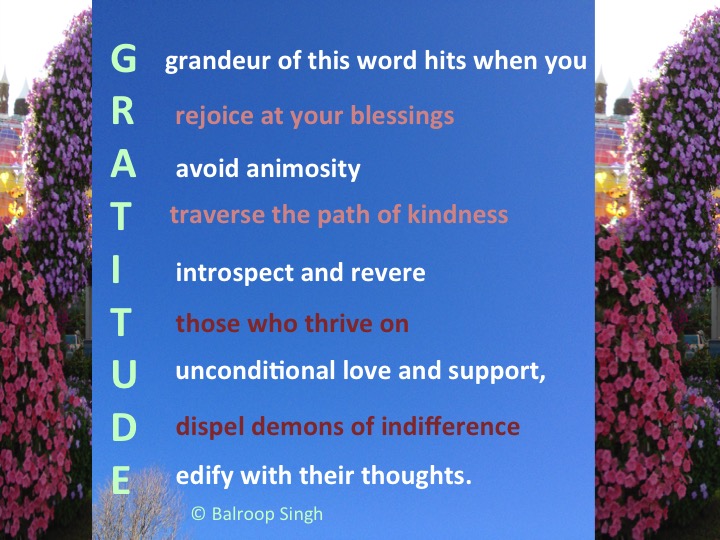
Gratitude and Gifts

Gratitude

                                                Inundated by friendly mail
                                                 I sat, staring at the gale
                                     That whooshed through your words
                                            It empowered my thoughts
                                             And impelled me to soar

                                        Its time to express my gratitude
                                        For the inspiration, the poetry,
                                          The reflections you shared
                                      Even those who just clicked ‘like’
                                        Filled my heart with delight.

                                               As the curtain falls
                                         On National Poetry Month
                                     I gift two eBooks, as promised
                                     To those who spoke in verses
                                   While sharing their deliberations

                                            Only a few ventured
                                         Making my decision easy
                                 My gifts go to Miriam and Pamela
                                  Pam surprised me with her knack
                                    Of creating magic on the track.
© Balroop Singh

Winners please check your email or twitter message box for claiming your gift.

Thank you for your support and contributions, much appreciated.

If you have liked this poem, please share it at your favorite social networks.

Grief, Struggle And Fame Are Interlinked #NationalPoetryMonth

Grief_Poem

Many of our favorite poets who inspire us, had to battle with life and its miseries. I have compiled some interesting and amazing facts from their lives to reiterate the facts that success doesn’t come on a platter; grief transcends all boundaries and the icy finger of death may squeeze all your dreams.

 Robert Frost sold his first poem “My Butterfly, An Elegy, to the New York Independent for $15. He was an extremely successful poet but his life was full of sorrow and suffering. His father died of tuberculosis when he was just 11 years old, leaving the family with just eight dollars. Frost’s mother died of cancer in 1900. His younger sister Jeanie died in a mental hospital, where she struggled with her mental illness for nine years. Mental illness apparently ran in Frost’s family, as both he and his mother suffered from depression and his daughter too was committed to a mental hospital in 1947.

John Keats, an English Romantic poet who is known for his brilliant poetry, vivid imagery and sensuous appeal died from tuberculosis at the age of 25. He received fame only after his death. His poems were not received well by critics during his lifetime; his reputation grew after his death.

S.T. Coleridge had bipolar disorder, which had not been defined during his lifetime. Throughout his adult life Coleridge had crippling bouts of anxiety and depression was treated for these conditions with laudanum, which fostered a lifelong opium addiction.

He is best known for his long poems, The Rime of the Ancient Mariner, Christabel and Kubla Khan, some of which were written under the influence of opium. He has given the English language the famous metaphor of “an albatross around one’s neck”, the quotation of “water, water everywhere, nor any drop to drink” and the phrase “a sadder and a wiser man.”

Walt Whitman, one of the most influential poets in the American canon, often called “the father of free verse” was very controversial in his time, particularly for his poetry collection ‘Leaves Of Grass,’ which was described as obscene for its overt sexuality.

Maya Angelou, best known for ‘I know Why the Caged Bird Sings’ became a poet and writer after a series of occupations as a young adult, including fry cook, sex worker, nightclub dancer and performer, cast member of the opera ‘Porgy and Bess’ and journalist in Egypt and Ghana during the decolonization of Africa.

When Angelou was three and her brother four, their parents’ “calamitous marriage” ended, and their father sent them to Stamps, Arkansas, alone by train, to live with their paternal grandmother. She was sexually assaulted by her mother’s boy friend when she was eight. It was her tumultuous life that molded her into a multi-faceted personality.

Mirza Ghalib, the last great poet of the Mughal Era, is considered to be one of the most famous and influential poets of the Urdu language but fame came to him posthumously. He started composing poetry at the age of 11. His verses eloquently expressed philosophy, the travails and mysteries of life.

Kahlil Gibran, a Lebanese American writer, a poet and a visual artist is the third best-selling poet of all time, behind Shakespeare and Laozi. Due to his family’s poverty, Gibran received no formal schooling during his youth in Lebanon. Gibran’s father was imprisoned for embezzlement and his family’s property was confiscated by the authorities. It was only when his mother took him to New York that he could attend school.

Emily Dickinson, a prolific poet lived much of her life in reclusive isolation. Considered to be an eccentric by locals, she developed a noted penchant for white clothing and became known for her reluctance to greet guests or, later in life, to even leave her bedroom. Dickinson’s poems are unique for the era in which she wrote; they contain short lines, typically lack titles, and often use slant rhyme as well as unconventional capitalization and punctuation.

For a poet of his stature, T.S.Eliot produced a relatively small number of poems. He was aware of this even early in his career. He wrote to J.H. Woods, one of his former Harvard professors, “My reputation in London is built upon one small volume of verse, and is kept up by printing two or three more poems in a year.”

Rudyard Kipling was born in Mumbai. (India) His parents had been so much moved by the beauty of the Rudyard Lake in Rudyard Staffordshire, (England) that when their first child was born they named him after it. In a 1995 BBC opinion poll, his poem ‘If’ was voted the UK’s favorite poem.

A 13th-century Persian poet, Rumi’s influence transcends national borders and ethnic divisions. Rumi has been described as the “most popular poet”and the “best selling poet” in the United States.

Source: Wikipedia

Compiled by Balroop Singh

Thank you for extending your support during the National Poetry Month by sharing your poems and reflections. Next post will announce the two winners of the gift that I had promised in the beginning of this month.

If you have liked this post, please share it at your favorite social networks.