Poetry Books with a Difference

I would like to share these poetry books with you, which touched me deeply:
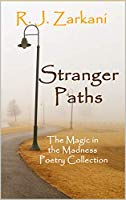
41NExciOU6L._SR126,200_Stranger Paths: The Magic in the Madness Poetry Collection by R.J. Zarkani speaks eloquently about war-torn Iraq and the eternal emotional bruises that a little girl carried within her, wondering why her father told her to get inside when she wanted to see the “fireworks making a day out of night,” – a child’s perspective about war.

All the pearls in this book belong to the same string that broke and scattered. Zarkani’s yearning to meet the child who “swallowed the smoke” and got lost in the explosions didn’t wane years after she migrated to an alien land, in search of peace and freedom. Roots pull her; stars and the clouds appear familiar but there is a strange disconnect that seems inexplicable, as she was told “you don’t look like a terrorist!”

Superb imagery that R.J. uses blends in her reflections about “creatures crawled out of her book,” a book that calls her, visions that haunt her, images of the past linger, fairies that lived on her kitchen sink still sing; memories stand before her, trying to sweep her away into the world she still loves… ‘shoes filled with mud’ seem dearer… ‘rain in the desert’ – a childhood memory returns as Raghad writes the poignant story of the moments she treasures.

41TYVhHDryL._SR133,200_Journey to the Rainbow’s End: A Drag Queen’s Odyssey by Forrest Stepnowski is a brilliant anthology of blank verse and a short story that dwells on the hope of being accepted the way one is… “To be my own star.” It gives voice to all those persons of LGBTQ community, who slip into the abyss of self-loathing because of orthodox, judgmental society that spews hatred against them, declaring them “gay,” “immoral” and “abnormal.”

Each poem in this collection makes a poignant appeal to the society to understand the pain and ridicule that they have to undergo because of the apathetic attitude of the people around them, who push them into the closet, compelling them to face “The silent horror of being” and are forced to snub “the darkest secrets” but who crave for love to lead a normal life.

This is a distressing journey of emotional upheavals, a clarion call to find their own voice and light by breaking free from the shackles that threaten to suffocate them, by accepting that strength lies within. This book must be read by everybody as it contains profound words for those who look down upon other human beings.
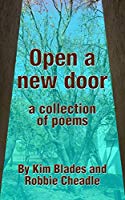
51h1UkHNvmL._SR125,200_‘Open a New Door’ by Kim Blades and Robbie Cheadle is a collection of poems, inspired from life in Africa and people who make it good, bad or ugly. All aspects are portrayed in a plausible manner.

Both Kim and Robbie have a similar style of writing blank verse, some of the themes too are identical. Realism is the hallmark of their poetry, as they talk about life and people in clear words; imagination takes a back seat. Deeply moved by poverty around her, Robbie has highlighted it in many poems. If ‘The Boys under the Bridge’ brings out the plight of the homeless youth, The Silver Lining underlines the uplifting spirits of a youngster carrying a load of recyclables with abandon, The Beggar’s Child mocks at the apathy of the passers-by but ‘The Golden Light’ focuses on helping the underprivileged children of a school in a squatter camp with books – a wonder gift for them.

Kim seems to be an ardent animal lover because many of her poems celebrate wild life and give a vivid description of how a cheetah hunts its prey, how mother cheetah nurtures her cubs, how a lion lies on golden grass, even her Utopia mentions “stamping buffalo.” Iconic South African birds too catch her attention to inspire a poem. The opening lines of ‘Lessons Learned in a rural village’ seem to be inspired from William Blake’s poem ‘The Little Black Boy.’

Some of the poems are too personal and comment on how life unfolds, offering unforgettable memories, moments of exhilaration and dismay, travails of a working mother and insecurities of an empty nest but they all make life worth living. Heaviness of this book would linger around you even when you finish and put it away.

Thank you for reading this post. Do you have a book in mind that has touched you deeply? Please share your reflections.

You can click here for more poetry.

If you have liked this post, please share it at your favorite social networks.

– Balroop Singh


How Poetry Can Inspire and Mold Personalities #NationalPoetryMonth

Poetry inspires and ennobles us

Poetry reflects life in all its hues; it is the choice of words, which makes a difference to the thoughts and sentiments that poets share. It speaks of countless experiences and puts forward the essence of life, if you pay attention to the images through which poets communicate.

Poetry enables us to understand the finer nuances of life; it nurtures the most beautiful emotions of love, trust, acceptance and empathy. A poet teaches without forcing any philosophy as he just shares his reflections succinctly, leaving the rest to the imagination and understanding of the readers.

Poetry develops creativity, flexibility, interpretational skills and critical ability effortlessly. It makes you intuitive, only if you read it without any prejudices, learn to appreciate it and read it carefully.

Let me share some verses that have enriched my personality:

“What is this life if, full of care,
We have no time to stand and stare?”

These lines from ‘Leisure’ by W.H.Davies have always stayed with me, a constant reminder to get down from the whirlwind of life and look at the flowers, the bees, the butterflies and dawn breaking at the horizon.

William Wordsworth’s wisdom made me understand that life is more than just earning and spending money. 
“The world is too much with us; late and soon,
Getting and spending, we lay waste our powers;—
Little we see in Nature that is ours;
We have given our hearts away, a sordid boon!” His poetry inspires us to lead a meaningful life and respect the spiritual link that connects man with nature and his supreme being.

John Keats defined beauty for me and nurtured my love for beautiful things that are mentioned in his poem ‘Endymion.’
“A thing of beauty is a joy for ever: 
Its loveliness increases; it will never 
Pass into nothingness;…but still will keep
A bower quiet for us, and a sleep
Full of sweet dreams, and health, and quiet breathing.

Emily Dickinson’s poem helps us understand success:
“Success is counted sweetest
By those who ne’er succeed.
To comprehend a nectar
Requires sorest need.”

Each line of my all time favorite poem ‘If’ by Rudyard Kipling teaches profound lessons, 
“If you can keep your head when all about you   
    Are losing theirs and blaming it on you,   
If you can trust yourself when all men doubt you,
    But make allowance for their doubting too;”… It encourages us to take pride in ourselves, develop patience, stay upright in the midst of lies, don’t get agitated by others’ demeanor, follow your dreams but don’t let dreams master you and avoid pretentions.

‘I am the People, the Mob’ by Carl Sandburg inspires us to rise against exploitation and social injustice. Look at his passionate appeal:
“When I, the People, learn to remember, when I, the People, use the lessons of yesterday and no longer forget who robbed me last year, who played me for a fool—then there will be no speaker in all the world say the name: “The People,” with any fleck of a sneer in his voice or any far-off smile of derision.”

Walter D. Wintle’s poem ‘Thinking has stood by me in the darkest moments, exuding light on the paths of life – a reminder that life’s battles are won by “the man who thinks he can.”
 “If you think you are beaten, you are
If you think you dare not, you don’t,
If you like to win, but you think you can’t
It is almost a cinch – you won’t.”

 ‘Last Ride Together’ by Robert Browning inspires optimism.

‘The Road Not Taken’ by Robert Frost exhorts us not to regret the choices we make.

‘The Man He Killed’ by Thomas Hardy questions the futility of war, in which soldiers have to kill strangers just because he “Was out of work…” and happened to join infantry.

The Little Black Boy by William Blake says a lot with just one verse: “I am black, but Oh! my soul is white,”

I have mentioned just a few poems that have made a mark on my personality. Thank you for reading this. Do you have a poem in mind that has inspired you or conveyed a strong message? Please share your thoughts.

You can click here for more poetry.

If you have liked this post, please share it at your favorite social networks.

Balroop Singh.

Reality and Imagination

Street art depicting a woman's face
Sue Vincent’s #PhotoPrompt

Brooding eyes, blasé yet discreet
Discerning depth of dark images
Wriggling away from the light
That glows to glean truth

Unstated grievances creep out
When I look within
All of you crawl like worms
Some faces visibly distraught

The artist could see you
My illusionary veil couldn’t shroud
Graphic secrets of thoughts
That groan under pictorial patterns

Onlookers may admire the art
Only I know the depth it conceals
Come and alleviate agonies
Shared stories satiate emotions.
© Balroop Singh, January 2019

Thanks to Sue Vincent for an inspiring Thursday #writephoto Imagination

You can click here for more poetry.

If you have liked this poem, please share it at your favorite social networks.

Thank you for your support. Please share your valuable reflections, they are much appreciated.

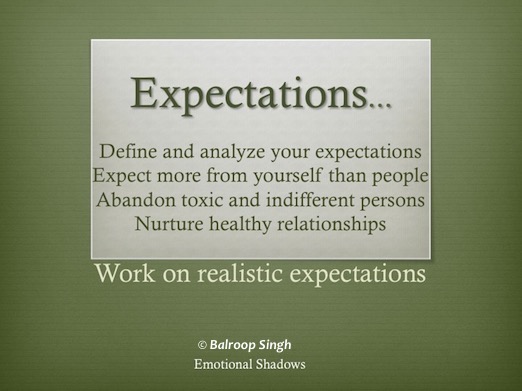
Expectations and Attachments Define Life


expectations

Recently I came across this statement, “The best way to get what you want is not want it.” The cynicism embedded in the above statement kept me awake for many hours. I had to pen down my thoughts to calm them. How can you call self-denial the “best way”? How can you quell your desires?

Expectation is a natural human instinct – a child expects attention, love and care. If he doesn’t get the basic care, his expectations don’t end there. He seeks them elsewhere.

Those children who grow up in misery and penury don’t get immune to expectations. Their eyes are always at the sky, anticipating all that they yearn for!

Our expectations flow like a stream that keeps widening as it touches the plains. The seeds of expectation are nurtured at a very early stage of life by our parents, teachers and friends.

This so called positive assertion of “giving up what you want” may have some spiritual connotation attached to it but tell that to a child or an adolescent and you would get the real looks! They may call you cynical; scoff at your advice and consider you too old to even interact with. Buddhist philosophy appeals only to the elderly.

Wants and desires are innate. They make us human. They are those streamers that inspire us to hang out despite the windy weather. They push us toward our goals, ignite a fire of excellence and lure us toward accomplishing more. Some of them lie dormant, waiting for the right opportunity.

Life would become meaningless and hollow without desires. True, they keep on multiplying; they may even disappoint us but without them all fun flies out of our lives. Expectations and attachments define life for us.attachments

Why attachments are essential: Initial attachments introduce us to people, they underline love for us and acquaint us with the basic values of bonding, care and respect. As children grow out of those attachments, ready to face the world, they feel connected with friends; they learn the value of love and nurture relationships to live a meaningful life.

What would life be without any attachments? All human emotions germinate from attachments, which may bind us emotionally but they keep us grounded to ennoble us. Only when we feel attached do we learn compassion. Solitude seems good only after having experienced all that human beings can offer to each other. Detachment is a mere word that has failed miserably despite its valuable aspects. When we try to detach, we have to snub what our heart says. Who would like to do that?

Needs have a profound connection with attachments. Why do you need a smart phone? Our grandparents could do without it yet somebody thought of better connections. Needs, however absurd they may seem, lead us to progress, to a better society and fulfilling life.

Desires keep us motivated; they encourage us to strive, to keep going despite all the odds. They shape us into better human beings. They add fresh dimensions to mundane aspects of life.

Giving up expectations and attachments is like giving up your hold on life. I am sure all of you would agree. Please share your reflections.

If you have liked this post, please share it at your favorite social networks.

Balroop Singh.

Unknown Love


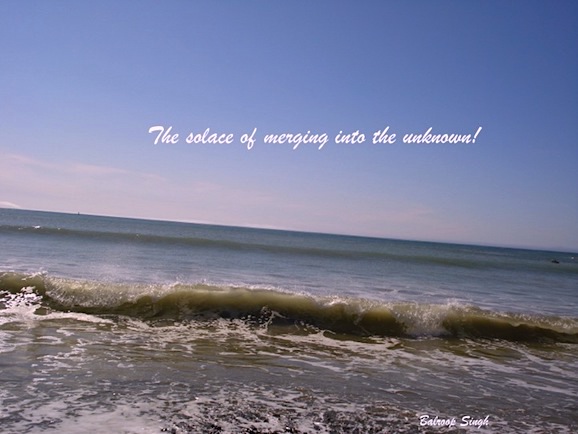
image of ocean and a wave rushing to the shore

I could hear the waves
Whispering softly into my ears.

I could see them breaking at my feet
Tugging at my heart.

I could discern the echo
Reverberating all around me.

I could envision their calling
Loving invitation into their arms.

I could feel the sweep
Getting carried by their stroke.

I could hold the breezy touch
Caressing my fingertips.

I could embrace the love
Profound and intensely distinctive.

I could experience the peace
Twirling with them, again and again.

I could sense the solace
Of merging into the unknown.

The unknown blue, enveloping all
The luring love, alluring all.
© Balroop Singh

Do you ever feel the same kind of pull… the feeling of merging into the surroundings?

Poetry
Look inside

The above poem is an excerpt from my latest poetry book Timeless Echoes. You can click on the link to look inside.

If you have liked this poem, please share it at your favorite social networks.

Thank you for your support. Please share your valuable reflections, they are much appreciated.