Growing Intolerance In Societies – Who Is Accountable?

Intolerance

I have always been deeply disturbed by intolerance and wanted to write about it but I have always turned my face the other way, trying to avoid it, knowing well how deep-rooted this sentiment is and how less I know about it.

I have tried to understand it in my own limited arena, how it develops and gets aggravated within the families before it spills out onto the streets.

Quite early in life, I had my first encounter with this emotion albeit I had no idea that people call it intolerance and it is so widespread! With the passage of time I learnt that intolerance is the refusal to accept, appreciate and respect the views, beliefs or behavior of a person or a social group.

I also learnt that we are not born with intolerance. Children are too innocent to understand the depth of this term, which is defined for them by their parents, environment and the society in which they are raised.

So it is a learned behavior. It is most often trigged by fear or insecurity that people face in their immediate environment.

It is a universal phenomenon…in some societies it is camouflaged under empathy and help that leaders try to offer, only to exploit it for their own benefits, which could be political, religious or related to caste and color.

Mahatma Gandhi felt, “Intolerance is itself a form of violence and an obstacle to the growth of a true democratic spirit.”

We inflict this violence on each other, without caring for the emotional hurts it causes especially on young adolescents who have to deal with it in educational institutions and neighborhood.

Role of families: As a child, whenever I visited my grandmother’s home, I saw a weird form of intolerance towards the working class, who could not mingle with the landlord families, had to sit on the floor and eat in their own plates, which had to be kept separate. Feudal masters looked down upon them just because they were poor and worked in their fields.

It is quite obvious that the children of such houses would grow up with the feeling that this kind of behavior was right and that is how it got embedded in social set up. It could never be rooted out despite the best of opportunities and laws. It still exists in a veiled form because certain people refuse to accept the underprivileged and the downtrodden as their equal. They share their beliefs and opinions with their children in their own narrow-minded way and the vicious circle continues.

Intolerance

Role of groups: There are fanatics who want to underline the importance of their own caste, region, race or religion. They create such groups to highlight the superiority of their race or religion. They keep raking the age-old traditions to prove that their ancestors had rightly created the class divide. Their constant endeavor is to sow the seeds of narrow-mindedness in the impressionable minds.

The atrocities of the past, the brutalities, which were inflicted by a certain group of people, are never buried. They are kept alive by talking about them so that the posterity remembers the prejudices, so that the youth can be instigated in the name of never ending vengeance.

Education, awareness and globalization has done little in eradicating intolerance, which is much more deep-rooted than we think. It is associated with the biased views of a parent, a teacher or a leader whose influence on growing children cannot be prevented.

Role of educational institutions: Children who study in minority schools and convents are conditioned to follow a set of rules, which contribute immensely to their development. They may not be told that others are lesser than them but the way their own beliefs, principles and philosophies are drilled, do create a subtle feeling of superiority for their own group.

Some of those who are confused try to rationalize those beliefs and principles but many more are easily carried away by the radical groups and that is how fringe elements get an impetus to keep themselves active and alive to exploit the sensitive matters.

5655694025_dogs_and_diversity_xlarge
Image courtesy: http://www.sodahead.com

Intolerance is also self-perpetuated and controlling this emotion is possible:

  • Think rationally
  • Learn to control anger and jealousy
  • Be sensitive to the hurts of others
  • Nurture kindness and compassion
  • Respect the opinion of others
  • Don’t feed doubt, vengeance and outrage

Intolerance is another form of discrimination. To my mind, they are synonyms.

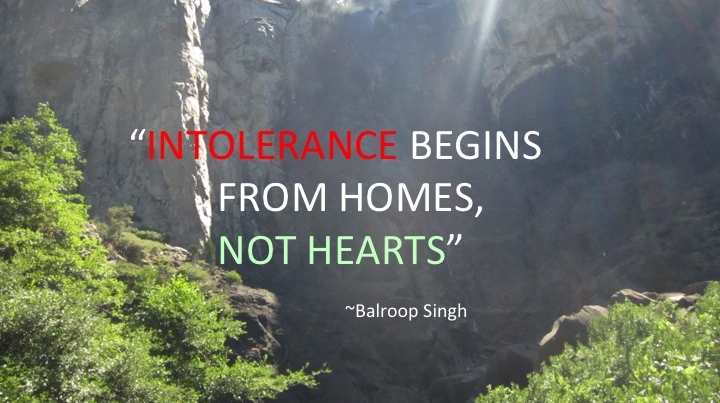
Intolerance begins from homes, not hearts.

If you have liked this article, please share it at your favorite social networks.

Thank you for your support. Please add your valuable comments, they are much appreciated.

Balroop Singh.
 

When Our Emotions Get Hurt…

People,detach

I am sure you can relate to this. We all have bruised egos, bleeding hearts and moments of discontent. Emotional upheavals are a part of our lives.

We have a lot of expectations from our near and dear ones, especially our parents, children, siblings and friends.

We love them and expect the same kind of love in return. We do the best for them and think that they would understand us. Many times they misinterpret our love as interference.

Our definition of love could be different from theirs. Their lack of interaction with us may disappoint us, we may wonder where did we err, which has made them selfish and self-centered and we may even feel guilty for having failed to have that kind of warmth we anticipate.

Too much love boomerangs. It loses its sheen. Our emotions get hurt.

At such moments, try to put yourself in their shoes. Just think that their perspective could be unlike ours.

I know it takes a lot of time to rise from the dumps of emotional distress…

The babies we nurtured are grown up adults now, emotionally and financially independent. They like to take their own decisions.

The parents who doted on them seem to be superfluous. You could be one such parent.

The siblings who shared all their secrets with us have their own soul mates and children, who are dearer to them than us.

We may feel isolated.

The friends we had have moved on with their life.

When situations change, attitudes also change. Emotional balance appears to be the most significant aspect of such a scenario.

How to handle emotional hurts?

Learn from hurts: We have to accept change, which is an inevitable law of life. All relationships evolve with the passage of time. Prepare yourself for change in the outlook of people around you. Please understand that their own life and pursuits are more important for them. They don’t mean to hurt you; they just have a different perception, which you may not appreciate.

Learn to trust them: Your contribution to the growth and development of persons in your life could have been gigantic but now is the time to sit back and take pride in their success and happiness. You can trust them to take responsible decisions. If they seem to go astray, you can only help them by reminding them but they will learn only when they stumble.Love you

Give up control: It may seem very difficult to give up the role of mentoring your children yet you cannot control them all your life. The sooner you realize this, the better it is for your mental health. Don’t give them any advice if it is not asked.

Let them be what they choose: The best gift you can give to your children and siblings is – let them be what they want. It may be against your own ideals and expectations but you cant snatch their happiness by imposing your view on them.

Support them: Despite the differences and bitterness, which creep into relationships slowly, don’t alienate yourself. Keep in touch and support their decisions. Give your opinion only when asked to. Remember you are no longer the most important person in their lives.

Respect yourself: If you feel alienated at some stage of life, step back and introspect. Let all the thoughts gather and sift the ones, which can help in getting over the hurt. Brooding or letting the past linger around you can only accentuate the ache. Let go the past, give it some time to wilt and wither. You will emerge stronger.

Cultivate emotional balance: Don’t get carried away by the attitudes, which could hurt your emotions, don’t try to be judgmental even if the indifference of a dear friend or a sibling is irksome. Learn to give them a benefit of doubt as your thoughts could be far fetched.

Find new activities: Keep yourself busy, join a club, a recreation center or revive one of those hobbies you couldn’t pursue. Spread your arms and feel free. If you are an introvert, take refuge in your old journal and share your feelings with it.

Nobody listens to our emotions as ardently as our journal.

“The turning point in the process of growing up is when you discover the core of strength within you that survives all hurt.” – Max Lerner

How do you deal with emotional hurts? I am waiting for your answers.

If you have liked this article, please share it at your favorite social networks.

Thank you for your support. Please add your valuable comments, they are much appreciated.

Balroop Singh.

How Unspoken Words Harm Our Personality And Relationships

Unspoken words

A spoken word is better than those, which are kept within the heart. Unspoken words keep struggling; they create negative images in the minds of people who want to hear them and who keep suppressing them.

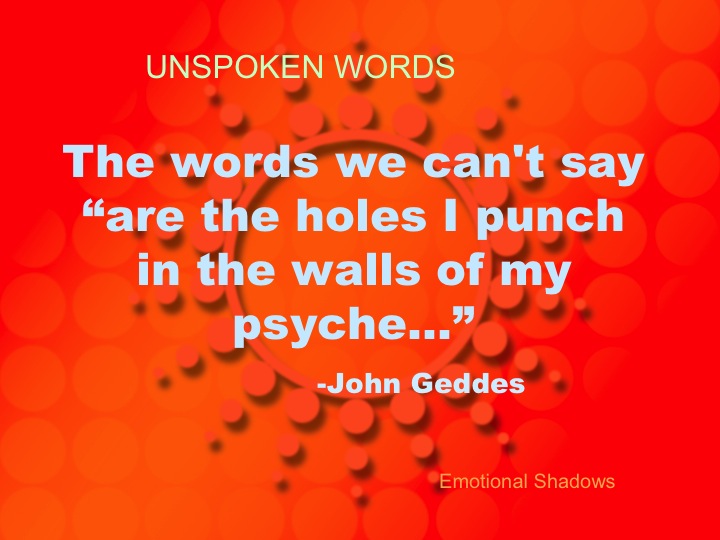
The words we can’t say, observes John Geddes “are the holes I punch in the walls of my psyche…” They keep growing deeper and wider with time. The unspoken words keep falling into those holes and it becomes hard to retreat them.

Unspoken words hurt. They hurt not only you, as they are emotionally strenuous but they are painful for those too who expect them to be shared. The silence keeps growing with each passing day till it becomes a habit.

You keep burying all your secrets, all the plans, even those well-intentioned ideas within your mind and when they tumble out, they provoke an untold psychological trauma for your own loved ones.

They wonder what is their role in failing to get closer to you; they start doubting their own love and misunderstandings start budding. They can never get sorted out if words remain unspoken.

Unspoken words carry emotional baggage. When feelings and emotions are not shared, they create an unknown wedge between relationships. They breed anger and angst and there is no limit to these negative emotions.

Non-communication can lead to serious rifts and it is one of the major reasons of drifting apart. Emotions need an outlet, a channel that makes them flow spontaneously.

Emotional outbursts are better than carrying an emotional baggage.Unspoken words

Repressed emotions are like a volcano and unspoken words become a lid for them. I am sure you can understand what happens when a volcano bursts!

Unspoken words create negative energy, which keeps on multiplying as people wait for the right time to share their feelings. Such a time never comes, as the right time is that moment when you feel like saying something. Once you suppress those words, you become adept at doing so each time.

Negative thoughts often change our personality as we become skeptical. Even the right-minded people, the well-wishers seem threatening and we want to shove them out of our lives.

Unspoken words conceal your real personality. How do people know about you? It is only through our words that we share about various topics and issues that others form and opinion about us. Even introverts interact with words, which may be too less!

Unspoken words make us seem hypocritical. Others get an opportunity to judge our personality according to their own perspective. If we don’t make an effort to be friendly or nice, people draw their own conclusions about us, which may not be always accurate.

Why people hold words?

  •  They don’t want to hurt others
  • They want to hide their feelings
  • They may be having some secrets
  • They could have been snubbed in childhood
  • They could be cynical or hypocritical
  • They could have been trained to do so

You can understand very well that it is all about the molding of personality, which is influenced by various factors. Whatever the reason may be, unspoken words affect us eventually. They lead us to breaking down of ties; leave us rudderless in the sea of relationships.

Do you hold your words? Is there any other reason for that? I would love to hear your views.

If you have liked this article, please share it at your favorite social networks.

Thank you for your support. Please add your valuable comments, they are much appreciated.

© Balroop Singh.

Pain…My Antidote

Nearer to thee, my pain
Nearer to thee…Pain
Now I have embraced you,
Conquered you!
You have become my antidote,
You can no longer break my spirit,
You were my constant companion,
Now I have befriended you,
Made you my dearest confidant

You have always mothered me,
Rocked me, pushed me around
Sometimes pricked me
In the form of a sibling,
Made fun of me,
Challenged my capabilities
Many times you have
Surrounded me with
Selfish, self-centered,
Incompetent, insecure people.
You have flattered me
In the form of fair weather friends.

You have made me suffer in silence.
As a child, I could not confront you
But growing with you
Emboldened me, enriched my life,
Made me realize
You cannot even touch my soul.
I have emerged stronger,
Kinder, perceptive, forgiving
To embrace you with all the humility.

© Balroop Singh. (All rights reserved)

You can click on Sublime Shadows of Life by Balroop Singh to read more such poems.

If you have liked this poem, please share it at your favorite social networks.
Thank you for your support. Please add your valuable comments, they are much appreciated.

Why Are People So Insensitive?

InsensitivityDo you respect the feelings and emotions of others? Do you value the care and love of the dear members of your family? Why do some people choose to be indifferent and cold to our love and respect? Isn’t affection reciprocal?

These questions have troubled me many times and I have been trying to understand the reasons. Over the years of studying various persons and their demeanor, I have drawn some conclusions.

They may not be wholesome but they do offer some interpretations.

There are people who make you feel insignificant, who don’t respect your views, who try to belittle you. We all come across such people and sometimes we wonder what is their problem! Why is it so hard to impress them?

The reasons could be:

Insensitive people don’t care! Their own opinion, needs and self-esteem are so significant that they can’t think beyond that. They may not communicate it openly but their body language, their looks and their silence speaks volumes.

They lack emotional quotient: Emotional quotient is the ability to understand and handle our emotions in such a way that we appreciate the sentiments of others, learn with each step, each experience and move ahead, without getting emotionally scared or charged. Insensitive people are emotionally challenged. They cannot perceive or assimilate emotional vibes. They consider emotions to be superfluous and therefore they turn a blind eye to the affection of people around them.

They pick it up from family environment:  Our upbringing makes a gigantic difference in making us considerate, respectful and thoughtful. A family that nurtures the values of being reverential and selfless passes them on to posterity effortlessly. If selfishness and callousness is not checked at an early age; if some member of the family exhibits such traits, children unconsciously pick them up.

They are insecure and jealous: It is hard to believe but it is true! It is their own insecurity that makes people insensitive. Other members of the family seem to be their competitors. They tell themselves that there is no competition but actually they make it so in their own minds. They want all the attention, they want to impose their views and feel all-important. Some childhood insecurities could be driving their thoughts, which they choose to conceal.

They are selfish and self-centered: When we give top priority to our own interests, when we expect even our spouse and children to follow us in all our decisions, when we don’t see beyond our own desires and expectations, how can we develop sensitivity towards others? It doesn’t strike us that they may not like our choices and if it is pointed out, we tend to take offence.

They are puppets: Insensitive people are weak-minded and are usually controlled from behind. They tend to dance according to the tunes of their puppeteers as they have been conditioned to believe them blindly. All their sensitivity and loyalty leans towards their manipulators and they are likely to pick up the traits of those persons who could be their most respected mentors. They behave the way they have been told to, without using their own logic.

They learn to become manipulators: Those who do not react to manipulations aggressively absorb this conduct unconsciously and insensitivity is one such peculiarity. Insensitive people seem to have one-track mind. Since they have been brainwashed for a long time, they fail to recognize the emotional aspect of feelings and opinions.

Sensitivity

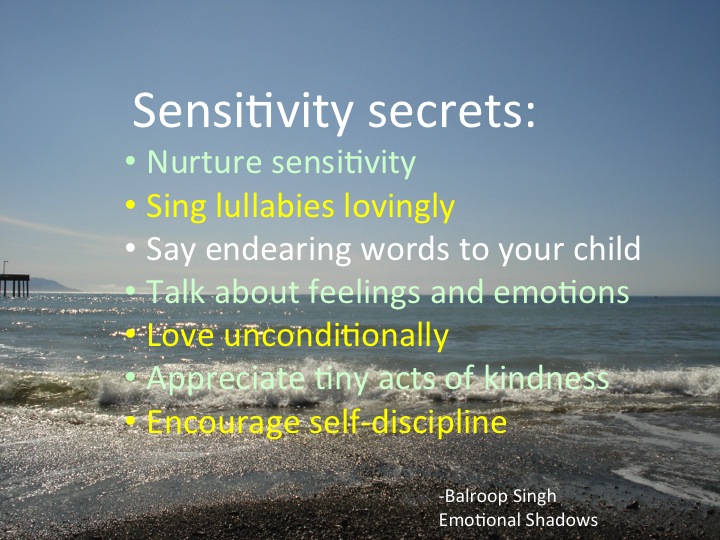
Are they incorrigible? It is very difficult to change such people as they consider themselves to be superior, their self-image is far better in their own eyes than what others consider them to be and they don’t want to be directed. They detest being told that they lack something. But that doesn’t mean we should not confront them. If we keep telling them that they need to rethink, that their demeanor is unacceptable, they might introspect and make some efforts to learn being sensitive.

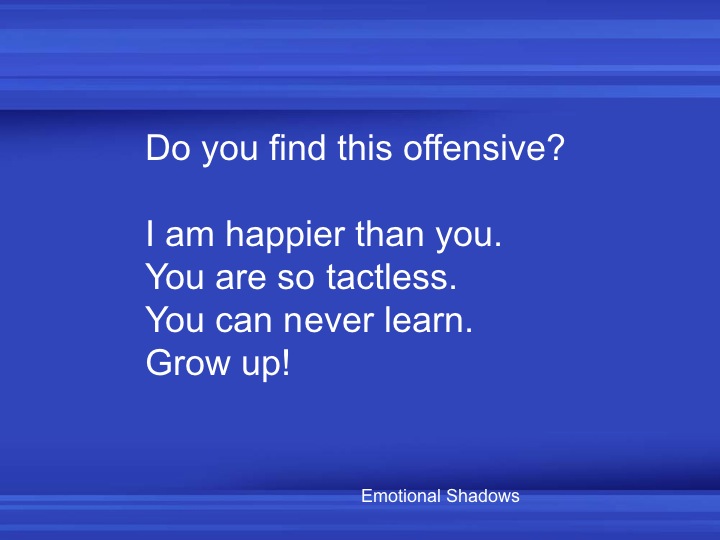
While society immediately points a finger at insensitive remarks made against protected groups, this kind of behavior is often ignored in families.

You may like: How To Deal With Insensitive People

Do you know any insensitive persons? How do you react to them? Do you ignore their behavior? I would love to hear your views.

If you have liked this post, please share it at your favorite social networks.

Thank you for your support. Please share your valuable reflections, they are much appreciated.

Balroop Singh.