Religion Or Spirituality – What is Your Choice?

religion-3452582_960_720
I am veering toward the thought: “Religion is the opium of masses.” Not that I didn’t try to explore its depths. I approached it with an open mind, I have observed its nuances from a closer angle and have even discussed it with devout followers and youngsters.

Religion is confusing. I have tried to understand it in many ways, most interesting being asking the young and the free minds who thought they were religious. Why – “because they were told to believe in it and follow its rituals.” Why – because “their parents told them to.” But some of them spoke honestly and admitted that they were confused.

To begin with religion may provide emotional security, unknown anchoring may ease angst and promote hope. It may inspire to live a meaningful life. I agree that it offers solace but all that is transitory.

Let’s nor forget the real face of religion:

  • It imposes arbitrary rules and rituals
  • It thrives on fear
  • It tries to control you
  • It encourages you to follow illogical path
  • It blocks freethinking and tries to condition your mind
  • It creates divide and polarizes communities
  • It has been used for accomplishing selfish goals

Religion may be confusing but easier to follow, as it doesn’t demand any understanding.

Spirituality is easier to understand but spiritual awakening dawns slowly; it is connected with our psychological growth, which is quite natural. Within us lies a light, a light of thoughts, a light of sanity, of ethereal happiness the light that liberates, which may become divine at some point of time, if we make an effort.

Spiritual awakening starts unfolding itself when we learn to look within; sometimes it astonishes us with its presence in some unknown crevices of our heart.

Spirituality is just being in harmony with yourself, exploring your thoughts and empowering them, delving deep into what you want and not being led by the so called Gurus. It only comes with understanding people and the world. You can’t expect a teenager to be spiritual, as it is developing your intuitive power and listening to your inner voice.

When we start discarding negative thoughts, when we begin to understand the feelings and emotions of people around us, when we adapt to changes without any grunts, when we adopt a positive approach to life, when self-healing becomes our goal – we may be gearing towards spiritualism.

Spirituality

It is an accomplishment as…

  • It leads us to emotional maturity and a deeper understanding of self.
  • It acquaints us with the darker aspects of our personality.
  • We can recognize the emotions that weaken us.
  • We develop the ability to embrace pain.
  • We learn to bridge the gap between pain and pleasure.
  • We cultivate the resilience to face inner demons, which we flee from.
  • We become sensitive to disparities around us.

Spirituality, as we know today has detached itself from religion and centers around values and humanistic ideas. It concentrates on personal wellbeing and inner peace.

It emphasizes on meditation, mindfulness, tolerance and ethics.

Yes, it matures us; it keeps us grounded but it doesn’t compel us to become another Buddha or his follower.

If you have liked this post, please share it at your favorite social networks.

Thank you for your support. Please share your valuable reflections, they are much appreciated.

© Balroop Singh.

How To Know Yourself?

Know Yourself

Do you know yourself?

Yes, I know your answer is positive but my next question is: How much?

If you really know yourself, try writing down ten points each about your personality, aspirations and relationships, to understand what I am trying to say.

As we shed off our childhood and adolescent illusions and step into the real world, we realize that life is much more than just dreams and expectations.

First we have to define those concepts, break them into pieces and perceive what is going to work for us. We have to anticipate the range of our flight. It is at such a time that that we start understanding ourselves.

Knowing your real self begins with a journey within – a journey we never dare to undertake! We invent excuses, delude ourselves thinking we have no time; sometimes we may be genuinely too busy to introspect.

We live in compartments, we perform different roles, sometimes we have to pretend to be what we are not and thus we don’t pay much attention to our true selves.

In one of the interview sessions, the one basic question we asked the interviewees was: ‘what are your strengths and weaknesses?’

Invariably, they stumbled upon this question. They paused to think and could only mention one or two of them.

As I smiled at them to ease the situation, a serious dialogue would emanate in my mind. I snubbed it at those times to introspect in my leisurely hours, to understand why this was such a difficult question.

While I could come up with many answers so far as my own strengths were concerned, weaknesses would elude me and I had to think deeply to dig them out.

Probably we try to push our weaknesses under the carpet.

To know yourself, know your weaknesses and your fears even before you know your strengths. Those monsters of fear that we try to shove into the deepest crevices become empowered and keep lurking around the corners. The shadows of those fears dissipate only when we pull them out into light and talk to them.

To know yourself, try to answer the following questions:

  • How many fears are still lurking around you and how many have you buried temporarily?
  • How many lies do you tell yourself to satiate your ego?
  • How much have you learnt from your mistakes?
  • How much wisdom have you picked up from your surroundings?
  • How much of your laughter is genuine?

To know yourself,

  • You have to understand your emotions and capabilities and how far you can go to accomplish your goals,
  • How well you can handle your failures and your unfulfilled dreams,
  • How much you would like to acquire in terms of material possessions,
  • What are your boundaries,
  • How much do you care for the people around you

“Knowing others is intelligence; knowing yourself is true wisdom.” ~ Lao Tzuknow-yourself

Self-confabulation for knowing yourself:

We often talk to ourselves to clarify our doubts, to form our views and overcome the difficult situations. It is this conversation, which acquaints us with our real self. Our opinions are usually shaped by people around us – our parents, teachers, peers, friends…our own perceptions are drowned in their guidance and control.

Self-reflection melts the mist of this guidance. It unshackles us and encourages us to think freely, to think differently so that we can take the reigns of our real self in our own hands.

How Sharing helps:

The next step is to share your thoughts with your digital partner, which just listens calmly and makes you think further. It doesn’t dishearten or criticize, it lets you relax and reach at a conclusion at your own will.

Earlier I used to write my wishes and doubts in a journal but with the advent of smart phones, we don’t even have to reach for a pen!

Some thoughts just come and go, some dreams are quite impractical and some may be beyond our reach but by writing them down, we can ponder over them, trying to figure out whether they resonate with us and exhort them out of our system to feel better.

Our true selves, our potential and determination get revealed at such moments when we try to dissect our thoughts and emotions with our own self.

How Introspection helps:

Are you capricious? Do you get influenced by others’ expectations? If you feel that you are walking the path, which makes you wonder where you are heading…introspection on daily basis, before you step into the land of slumber, can really help.

At such moments we don’t have the intolerance or the prejudice working against our colleagues, friends and kindred who may have wronged us. We just have a calm and patient mind, free from all ill feelings to understand our reactions.

That inner voice, which we snub in the presence of others, is most active now and we too are more receptive. You can discover the reasons of your indecisiveness; know how much you revere your values and what is your real passion.

Freedom of thought and action lies at the core of knowing yourself. They play a significant role in our development too. I didn’t know myself till I got these opportunities.

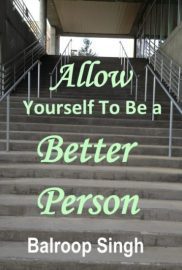
If you have liked the above excerpt from my book Allow Yourself To Be A Better Person, please click on the link to read more.

How did you discover your real self? How important it is for you? I am waiting to hear from you.

If you have liked this post, please share it at your favorite social networks.

Thank you for your support. Please share your valuable reflections, they are much appreciated.

-Balroop Singh

How Individualism Affects Your Personality

An individual facing the universe

Individualism is“a social theory advocating the liberty, rights, or independent action of the individual.”

Individualism gives prominence to self-development; personal achievements and independence of a person. When children grow up with the concept that they are enough, they have the potential to accomplish their goals and they have the freedom to take their own decisions, they value personal rights and their own space more than family values. A collective decision is considered oppressive.

On the surface individualism seems to be perfect as it offers absolute freedom and infinite possibilities of following your own aspirations but dig deeper and ask those who get mired in internal strife. Ask those who blame themselves for their failure. Ask those who are drowning in the sea of anguish and yearn for help. Ask those who have to take anti-depressants to cope with the pressures of life.

While individualism adds confidence, self-discipline and self-control to our personality, many essential characteristics are disregarded.

Individualism makes us self-centered:

When you are encouraged to discover your potential or follow your passion, you develop the habit of thinking only for yourself. It is always your endeavor, your success and your happiness. Self becomes larger than siblings, friends and parents and when it is time to contribute significantly to your society, it seems a burden. Such individuals drift away from most of the family relationships and seem selfish.

Self-doubts grow bigger:

Who doesn’t have to deal with self-doubts? It is difficult to handle frustrations alone. Setbacks seem like monsters, failures have to be owned and faced alone, and loneliness grows into depression. When stressful situations are not shared, their dimensions keep absorbing your confidence. Therapists step in to reinforce the fact “you are enough” but self-doubts refuse to dispel. On the other hand, Asian cultures promote sharing personal problems with family and friends and they serve the purpose of re-igniting wavering self-belief.

Individualism creates disconnect:

Personal attitudes eat into the core values of respect, patience and generosity. Self gets so exalted that love for others seems to be a chore. You may learn tactful behavior but relationships rest on the plank of façade. Senior members of your family cease to exist for you and visiting them or looking after them is not your responsibility. Those who nurtured you with the best of their abilities seem superfluous and are expected to fend for themselves.

Individualism breeds insensitivity:

Individualism gives top priority to your own interests, you become insensitive to the needs and desires of your spouse and children. You expect them to follow you in all your decisions, as your perceptions fail to see beyond your own expectations. Aggressive behavior, violence, emotional instability, incoherence in families, lack of interest in community activities and mental health issues are directly related to individualistic culture.

Individualism, a product of the western world, has silently crept into those societies that believe in collectivism. They have always taken pride in raising balanced individuals because of close knitted ties that are nurtured, and values of respect, altruism and cooperation are imbibed naturally, while growing up.

As individualism flourished in the west, touching its highest forms of selfishness, collectivism evolved and absorbed some elements of individualistic culture, granting freedom of thought and expression, taking one’s own decisions but following family values too. Such individuals have the best of both the cultures. A healthy combination of both could prove beneficial for your personality.

Thank you for reading this. Please share your valuable reflections, as they are much appreciated.

If you have liked this post, please share it at your favorite social networks.

Balroop Singh.

Allow yourself To Be A Better Person

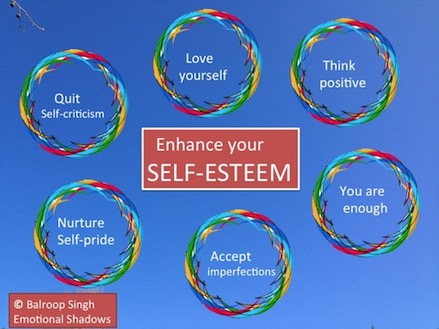
Do You Struggle With Self-esteem? 5 Ways To Bounce Back

How to enhance self-esteem

People around me could never hurt my self-esteem, not because I was never in such a situation but because I never let them! Even as a child when I was asked to apologize for no fault of mine, to please somebody’s ego, I refused. I knew I would be punished but I didn’t care!

My mirror has never told me that I am not the best or I can’t excel. I always knew I am much better than many.

Criticism of others affects me in a positive manner. I try to introspect and dismiss the judgment of others as their opinion. I try to work on my imperfections in such a manner that enhances my self-esteem.

What lowers self-esteem?

  • Negative home environment
  • Broken families
  • Bullying
  • Insensitive friends
  • Shaming by a parent or a teacher
  • Self-blaming
  • Intimidating or controlling partner
  • Demanding boss
  • Dwelling on your weaknesses

Self-esteem is not given; it is earned; it is cultivated and it is snatched when others try to smash it.
“One’s dignity may be assaulted, vandalized and cruelly mocked, but it can never be taken away unless it is surrendered.” Michael J. Fox

I have faced the worst of criticism and ridicule for being too thin and tall, for failing in Math, for writing beautifully and neatly but not completing a given test within the specified time, for keeping aloof and being arrogant. The list is very lengthy but the reality is that my self-esteem could never get shattered with the insensitivity around me because I knew those were hollow observations of jealous people. I always knew I am enough!

What can help?

Positivity: Read positive quotes, think positive thoughts, spend more time in the company of positive-minded people. Walk away from those who don’t respect your opinion. Try to understand that there is no age for personality enhancement and your growth and development is an ongoing process. Have faith in yourself and your capabilities. Don’t compare yourself to your friends or colleagues. Stop blaming yourself just because others try to shift their responsibilites.

Face your fears: If you let your fears hibernate, if you don’t discuss them even with yourself, they could shrink your heart, wound your spirit and keep consuming the remnants of your mettle to fight them. Let those alligators out of your mind. Discuss them with a confidant or a therapist. Learn to accept the fear of failure because only when we fail do we rise with renewed zeal and energy.

Forgive yourself: Forgiveness is that virtue, which sets us free and acquaints us with the finest emotions. It unshackles the chains of guilt that we weave around us. It soothes our mind. We can emerge out of those dark corridors of fears and insecurities that people around us pushed into. We can see ourselves in a new light. Self-forgiveness, even if we may be guilty of hurting others, is of utmost importance to build our self-esteem.Self-esteem quote

Quit self-criticism: Self-judgment is more detrimental than the nasty remarks of others. It makes us doubt our own intentions, it ruins our confidence, it pulls us back into the dumps of depression and lowers our self-esteem. Self-reflection is good as far as it encourages us to work on our weaknesses. It is better to train your mind to think positive, to remember that those who attack our self-esteem are actually dealing with their own insecurities.

Take pride in pursuing activities you love: Invest in yourself. Search within. Spend time with yourself and indulge in those activities that you enjoy. Stop pleasing people around you. Be proud of yourself and your little accomplishments. Self-love is not being selfish, it is being kind to yourself. Don’t allow anybody to disrespect what you like to do. Count your strengths and your blessings. Be yourself. The best freedom is being you.

Always remember – ‘the more you like yourself, the less you are like anyone else, which makes you unique.’

“Why should we worry about what others think of us, do we have more confidence in their opinions than we do our own?” Brigham Young
Thank you for reading this. Please share your valuable reflections, as they are much appreciated.

If you have liked this post, please share it at your favorite social networks.

Balroop Singh.

Why Do People Bully?

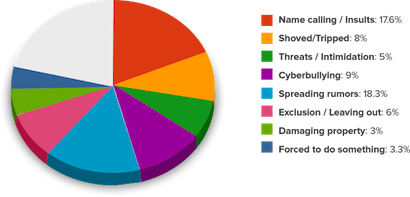
A bully is “a person who hurts, persecutes, or intimidates weaker people.” I am sure you can relate to this definition of a bully as we have met such persons either at home, school or work place.

Bullies target those who are coy, sensitive or are not psychologically strong to face unsavory remarks. Bullying seems to belong to antiquity and must have originated with human existence as it is embedded in the behavior of some people.

People bully:

chart-icn
Image from Google
  • To intimidate
  • To gain control
  • To satisfy their ego
  • To prove their power
  • To settle scores
  • Due to low self-esteem
  • Out of frustration
  • Out of emotional deprivation
  • Just for fun

Bullying begins at home and many children pick it up from their parents who might be arguing, threatening or pushing the partner to the wall to prove his/her point. So bullying is a learnt behavior.

Sometimes a parent sets an example through his own rigid behavior and high expectations. He may alienate himself from other members of the family. Children who grow up in emotionally insensitive families fail to learn the virtue of empathy. They learn to take pleasure in the pains of others.

Sibling rivalry and favoritism within a family leaves an indelible mark on the psyche of children. They either lean towards bullies or develop a low self-esteem. A girl child who is constantly badgered for being a liability and told that she must learn good behavior, as she has to get married is bullied with such words! This kind of attitude encourages the male sibling to bully her further. She learns to accept this kind of verbal and emotional bullying at her own home.

When parents are indifferent to making fun, teasing and hurting amongst siblings and don’t take punitive measures to stop such behavior, a bully may feel encouraged, as the mute message that reaches him is that such a behavior is acceptable.

In some cases children who like to bully could have been neglected at home and they grow up with the notion that nobody cares for them.

Lack of positive role models in our lives, dominance of leaders who bully and coaches who encourage the players to be aggressive give a boost to such behavior in our society.

Bullying at school is accepted as normal aggressive behavior of some children. It may begin with a little fun or unpleasant remarks out of jealousy but it doesn’t stop in case of an introvert who doesn’t share his thoughts. It is often neglected till it acquires gigantic proportions and could have already proved psychologically detrimental for the victim.

First and foremost, bullying needs to be reported to a teacher or a parent. Students who choose to fight their own battles or ignore inappropriate behavior indirectly encourage a bully.

Second, it is essential to take some action against bullying to set an example for others and send a clear signal that such a behavior would not be accepted.

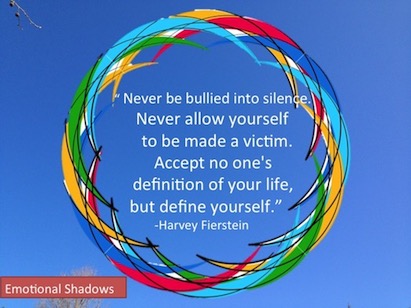
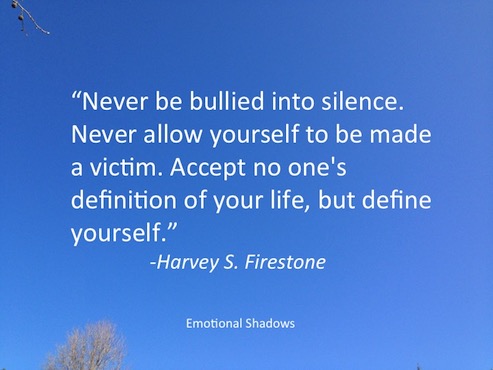
Third, please remember… Bullying never has to do with you. It’s the bully who’s insecure,”says Shay Mitchell.Bullying quote

It is extremely important to sensitize children about mutual respect and kindness at an impressionable age. Talks, discussions, projects and workshops, which focus on behavior could be organized at school to nurture compassion and empathy.

It is quite challenging to approach a bully and criticize his inappropriate remarks. He may not be responsible for them. A teacher who knows her students has to approach them gently, without hurting their sentiments and self-esteem. The focus has to be on correction and not criticism of behavior.

If we dig deeper, it can be discerned that bullies too need help. Such children are themselves the victim of some insensitive behavior at home or are upset with their own self. Their own demons are larger than life. They would never share the real reasons of such behavior. Some of them may not even be aware of the reasons and the consequences of bullying on their personality.

A bully is a hard nut to crack. The right approach would be to talk to him, show him positive approach towards life without actually hinting at his behavior. A teacher who knows a bully’s behavior or a psychologist in a group can do this. While group therapy can be helpful in some cases, such a student needs a close monitoring. Parents too have to step in if they are really concerned.

When bullying enters work places, it becomes uncontrollable as employees accept it calmly with the cliché… ‘Boss is always right.’ I have heard that phrase a thousand times and told to ‘accept’…even injustice! At this stage of life when we are capable of standing against bullying, we look the other way.

I have seen that people have their own reasons for accepting such behavior. Some don’t want to lose their job; some want promotion or favors while many are cowards who have been conditioned to become a ‘yes-man’ for the sake of peace. They become the cronies of those who sit in the comfort of their chairs to bully through their henchmen and smile at their successful strategies.

I have met many bullies but refused to surrender to their dirty games. I was always guided by the words of Lincoln – “I would rather be a little nobody, than to be a evil somebody.” 

How many bullies have you met? What was your approach?

Thank you for reading this. Please share your valuable reflections, as they are much appreciated.

If you have liked this post, please share it at your favorite social networks.

Balroop Singh.