When Darkness Overwhelms…

When darkness overwhelms

My blogger friend Joe Perrone recently asked me whether I have written any fiction. This is my answer to his question:

An excerpt from the book I hope to finish one day:

This was my haven, my little island of solace where I could talk to myself. It was not always so soothing as in this dark room I have spent many hours, all alone, weeping, wishing and praying. I have spent many days thinking…what was my fault, why was I blamed, why was I slapped. I have often cursed myself for offending others.

I looked out of the little window to see some light. I craved for company, a friend, a loving person who could answer my questions. It was at such times that I tried to analyze people with my little and limited thinking. The world appeared to be a cruel place, emotions seemed quite useless and ‘love’ was just a hollow word. How could those girls, my so called friends, say they loved their mom!

I couldn’t understand what is love, as I had never seen it. What I had seen was yelling and intimidation. Fear was a very familiar emotion and I got so close to it that it steeled me. This strength was building up with the kind of atmosphere I lived in. I didn’t share my hurts with anybody. I became an introvert. I could never be comfortable in the company of friends.

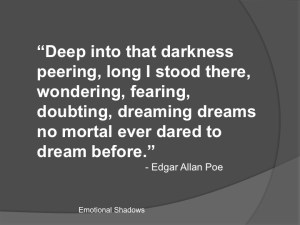
A day came when I lost all sense of time I spent in this room. It ceased to be dreadful as I made friends with those bare walls that terrified me. I liked being there, away from those insensitive people around me, pretending to be my well wishers, my so called parents, one of whom was always absent and the other always in rage.Darkness quote
I started enjoying those punishments in the dark room. I would hide my color pencils in some corner to enjoy my time in a fruitful manner. I stopped weeping and cursing myself. I invented new games of using my color pencils as candles to decorate my imaginative house. I learnt to smile and refused to be sad just because certain people took pride in disciplining me in their own manner.

If I emerged smiling out of this room, two of my bullish brothers would frown, wondering what gave that vitality to my cheeks! They mocked at me for having missed the regular play hour and I had a lot of homework to finish. Learning the tables took most of my time and I hated them.

Even this dark room could not stay with me for long. We moved out of that house into a brand new big house. Now we had our own rooms and there was no dark room. I knew all my friends abandoned me, probably I was what I had been branded to be – ill-fated!

I loved this new home, the fragrance of new paint and wood. I could experience the friendship of all the nooks and crannies that I explored the very first day I stepped into this house. It cherished my dreams, cushioned my lonely moments, provided solace to my disappointments, gave shape to my adventures and inspired me to aspire high.

Every wall was a supporting shelter, how much I could share my thoughts with them, silently! But I could never forget that dark room, which taught me how to dream.

Thank you for reading this story. Please share your reflections, they are much appreciated.

If you have liked this story, please share it at your favorite social networks.

©Balroop Singh.

Image adapted from

Why Are Some People More Emotional And Lovable?

Emotional intensity

Emotions rule the world…all emotional fools think so and I considered myself to be the one till I stumbled upon the research that recognizes ‘emotional intensity’ to be an authentic part of human brain.

These reflections are a consequence of tumultuous emotional phase that I have crossed successfully… emotions have been reigning over me for over a month now and I have understood why this space that I call my haven has been named ‘Emotional Shadows.’

However hard I try to push those shadows away, they keep on lingering, they come in various forms and always win me over to look at each situation from an emotional angle.

Probably I am born with a special streak, emotional aspects move me more than others albeit I am always searching for the reasons, which seem to be embedded somewhere in my DNA or my past.

Why are some people more emotional?

Why do some people get emotionally charged and others remain tranquil in the most challenging situations?

Scientists have found an answer to emotional intensity and responsiveness. Highly sensitive people are not abnormal and immature as they are dubbed to be! It is a ‘pattern of brain activation.’

They are extremely tuned to their environment due to an inherent trait called sensory processing sensitivity. (SPS) This trait is associated with their behavior and reactions.

Emotionally sensitive people are:79d1f6557a2f422c620a53a19e785a4b

  • More aware
  • More understanding
  • Self-motivated
  • Highly expressive
  • Intuitive
  • Instinctive
  • Easily perturbed

They experience the world in a different manner. They could be gifted with some special qualities, which surface when they feel loved.

They are extremely endearing and engaging. Only those who come closer to understand them can really appreciate them.

They are loved because of their emotional intensity, which can be discerned in their demeanor and conversation.

They find joy in little events:

Since emotions rule them, they can derive delight from insignificant events like running into an old acquaintance or a visit to their childhood home. Their attachments define them and they love to spend time in the past, reliving those moments and refreshing the memories.

They possess a passion for learning:

They dive headlong into every new activity that interests them. Age doesn’t dissuade them as they ride on the emotional wings of hope. Whatever they take up, they put their heart and soul into completing that task, without caring for the perils that they might encounter.

For them, all dreams are real:

They can never get deterred by the warnings and hazards rather get stimulated by them. They focus on their dreams with the same emotional intensity as their love for relationships, which are extremely important for them. They offer their best and expect the world to be good and kind.

Positive power drives them:

They may be having their dark moments but they don’t get frustrated easily as a unique positive energy within them makes them ride those dark horses to gallop away into the world they love to dwell in. Positivity is the hallmark of their personality. They possess the power to inspire others.

Emotionally sensitive people exhibit their emotions with pride and that eventually becomes their strength. They do not believe in hiding their sentiments and that is why they are lovable…only if you appreciate emotions!

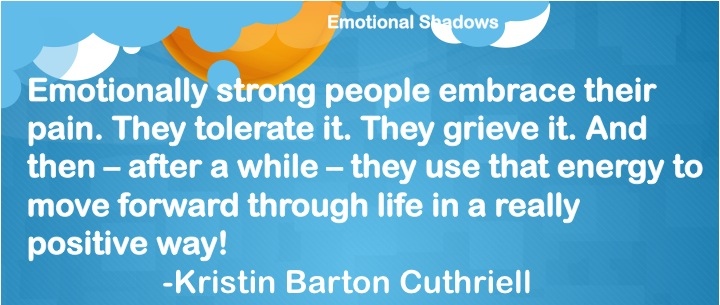
Emotionally strong

“Never apologize for being sensitive or emotional.
Let this be a sign that you’ve got a big heart and aren’t afraid to let others see it. Showing your emotions is a sign of strength.” – Brigitte Nicole

Are you emotionally more sensitive than expected? I would love to hear your views.

Thank you for reading this. Your support is immensely appreciated.

If you have liked this article, please share it at your favorite social networks.

Balroop Singh.

Growing Intolerance In Societies – Who Is Accountable?

Intolerance

I have always been deeply disturbed by intolerance and wanted to write about it but I have always turned my face the other way, trying to avoid it, knowing well how deep-rooted this sentiment is and how less I know about it.

I have tried to understand it in my own limited arena, how it develops and gets aggravated within the families before it spills out onto the streets.

Quite early in life, I had my first encounter with this emotion albeit I had no idea that people call it intolerance and it is so widespread! With the passage of time I learnt that intolerance is the refusal to accept, appreciate and respect the views, beliefs or behavior of a person or a social group.

I also learnt that we are not born with intolerance. Children are too innocent to understand the depth of this term, which is defined for them by their parents, environment and the society in which they are raised.

So it is a learned behavior. It is most often trigged by fear or insecurity that people face in their immediate environment.

It is a universal phenomenon…in some societies it is camouflaged under empathy and help that leaders try to offer, only to exploit it for their own benefits, which could be political, religious or related to caste and color.

Mahatma Gandhi felt, “Intolerance is itself a form of violence and an obstacle to the growth of a true democratic spirit.”

We inflict this violence on each other, without caring for the emotional hurts it causes especially on young adolescents who have to deal with it in educational institutions and neighborhood.

Role of families: As a child, whenever I visited my grandmother’s home, I saw a weird form of intolerance towards the working class, who could not mingle with the landlord families, had to sit on the floor and eat in their own plates, which had to be kept separate. Feudal masters looked down upon them just because they were poor and worked in their fields.

It is quite obvious that the children of such houses would grow up with the feeling that this kind of behavior was right and that is how it got embedded in social set up. It could never be rooted out despite the best of opportunities and laws. It still exists in a veiled form because certain people refuse to accept the underprivileged and the downtrodden as their equal. They share their beliefs and opinions with their children in their own narrow-minded way and the vicious circle continues.

Intolerance

Role of groups: There are fanatics who want to underline the importance of their own caste, region, race or religion. They create such groups to highlight the superiority of their race or religion. They keep raking the age-old traditions to prove that their ancestors had rightly created the class divide. Their constant endeavor is to sow the seeds of narrow-mindedness in the impressionable minds.

The atrocities of the past, the brutalities, which were inflicted by a certain group of people, are never buried. They are kept alive by talking about them so that the posterity remembers the prejudices, so that the youth can be instigated in the name of never ending vengeance.

Education, awareness and globalization has done little in eradicating intolerance, which is much more deep-rooted than we think. It is associated with the biased views of a parent, a teacher or a leader whose influence on growing children cannot be prevented.

Role of educational institutions: Children who study in minority schools and convents are conditioned to follow a set of rules, which contribute immensely to their development. They may not be told that others are lesser than them but the way their own beliefs, principles and philosophies are drilled, do create a subtle feeling of superiority for their own group.

Some of those who are confused try to rationalize those beliefs and principles but many more are easily carried away by the radical groups and that is how fringe elements get an impetus to keep themselves active and alive to exploit the sensitive matters.

5655694025_dogs_and_diversity_xlarge
Image courtesy: http://www.sodahead.com

Intolerance is also self-perpetuated and controlling this emotion is possible:

  • Think rationally
  • Learn to control anger and jealousy
  • Be sensitive to the hurts of others
  • Nurture kindness and compassion
  • Respect the opinion of others
  • Don’t feed doubt, vengeance and outrage

Intolerance is another form of discrimination. To my mind, they are synonyms.

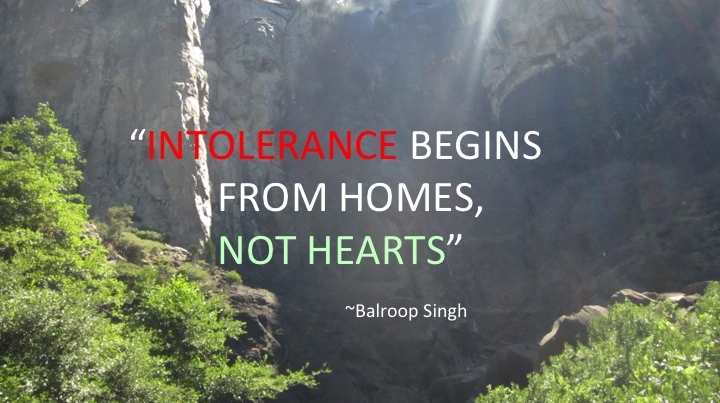
Intolerance begins from homes, not hearts.

If you have liked this article, please share it at your favorite social networks.

Thank you for your support. Please add your valuable comments, they are much appreciated.

Balroop Singh.


Why Are People So Insensitive?

InsensitivityDo you respect the feelings and emotions of others? Do you value the care and love of the dear members of your family? Why do some people choose to be indifferent and cold to our love and respect? Isn’t affection reciprocal?

These questions have troubled me many times and I have been trying to understand the reasons. Over the years of studying various persons and their demeanor, I have drawn some conclusions.

They may not be wholesome but they do offer some interpretations.

There are people who make you feel insignificant, who don’t respect your views, who try to belittle you. We all come across such people and sometimes we wonder what is their problem! Why is it so hard to impress them?

The reasons could be:

Insensitive people don’t care! Their own opinion, needs and self-esteem are so significant that they can’t think beyond that. They may not communicate it openly but their body language, their looks and their silence speaks volumes.

They lack emotional quotient: Emotional quotient is the ability to understand and handle our emotions in such a way that we appreciate the sentiments of others, learn with each step, each experience and move ahead, without getting emotionally scared or charged. Insensitive people are emotionally challenged. They cannot perceive or assimilate emotional vibes. They consider emotions to be superfluous and therefore they turn a blind eye to the affection of people around them.

They pick it up from family environment:  Our upbringing makes a gigantic difference in making us considerate, respectful and thoughtful. A family that nurtures the values of being reverential and selfless passes them on to posterity effortlessly. If selfishness and callousness is not checked at an early age; if some member of the family exhibits such traits, children unconsciously pick them up.

They are insecure and jealous: It is hard to believe but it is true! It is their own insecurity that makes people insensitive. Other members of the family seem to be their competitors. They tell themselves that there is no competition but actually they make it so in their own minds. They want all the attention, they want to impose their views and feel all-important. Some childhood insecurities could be driving their thoughts, which they choose to conceal.

They are selfish and self-centered: When we give top priority to our own interests, when we expect even our spouse and children to follow us in all our decisions, when we don’t see beyond our own desires and expectations, how can we develop sensitivity towards others? It doesn’t strike us that they may not like our choices and if it is pointed out, we tend to take offence.

They are puppets: Insensitive people are weak-minded and are usually controlled from behind. They tend to dance according to the tunes of their puppeteers as they have been conditioned to believe them blindly. All their sensitivity and loyalty leans towards their manipulators and they are likely to pick up the traits of those persons who could be their most respected mentors. They behave the way they have been told to, without using their own logic.

They learn to become manipulators: Those who do not react to manipulations aggressively absorb this conduct unconsciously and insensitivity is one such peculiarity. Insensitive people seem to have one-track mind. Since they have been brainwashed for a long time, they fail to recognize the emotional aspect of feelings and opinions.

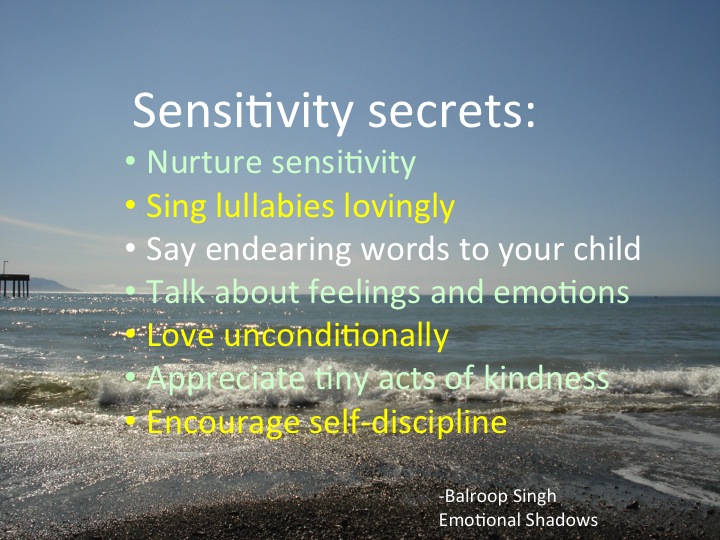
Sensitivity

Are they incorrigible? It is very difficult to change such people as they consider themselves to be superior, their self-image is far better in their own eyes than what others consider them to be and they don’t want to be directed. They detest being told that they lack something. But that doesn’t mean we should not confront them. If we keep telling them that they need to rethink, that their demeanor is unacceptable, they might introspect and make some efforts to learn being sensitive.

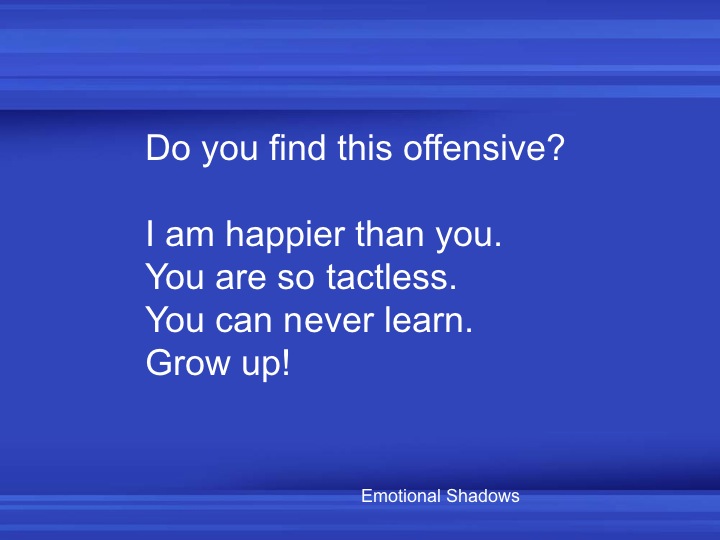
While society immediately points a finger at insensitive remarks made against protected groups, this kind of behavior is often ignored in families.

You may like: How To Deal With Insensitive People

Do you know any insensitive persons? How do you react to them? Do you ignore their behavior? I would love to hear your views.

If you have liked this post, please share it at your favorite social networks.

Thank you for your support. Please share your valuable reflections, they are much appreciated.

Balroop Singh.