Traditions, Conservatism and Giving

I had written this post in 2014, after attending a wedding. I need to refresh it, as nothing has changed.

Indian weddings are a spectacular show of wealth, wedged in traditions, rituals and extravagant customs.

They appear to be blissful happy occasions of celebration…till you peep behind the drapes!

Recently I had to be an obligatory part of all this razzmatazz, watching and wondering…when will we get out of these age-old cultural compulsions, which have been imposed on us.

“Sometimes tradition and habit are just that, comfortable excuses to leave things be, even when they are unjust and unworthy.”—Matthew Scully.

Traditions are woven into the web of our life, I know, but I always thought and convinced myself that they evolve with time.

How utterly, extremely erroneous were my thoughts, in hoping for brighter times!

The brides in India still belong to antiquity!

They may be highly educated, having the best of job placements, sometimes even earning more than the prospective grooms BUT…

They HAVE to bring along unlimited amount of gifts, which are all given by her father, rich or poor, all have to follow this tradition.

On the receiving end are the brazen parents of the bridegroom, whose mouths, as wide open as that of a crocodile, remain open!

They don’t have to give anything in return.

Traditions blind us, compel us to keep honoring them due to societal pressures but aren’t we part of the society?

Isn’t it our responsibility, especially that of the younger generation to break away from those norms which almost choke us, make us bankrupt, kill and burn our brides?

Yes, the youngsters do break some norms only when they want to!

But they remain mute spectators to the age-old system of giving and giving and giving….when they receive along with the bride!!

The Indian tradition of giving a daughter away is, in itself, an incomparable generosity in global history. She is expected to be a part of groom’s family, perform all household chores, bear and rear children, respect all the whims and fancies of her in-laws and stay away from her own parents and siblings.

She has to become a channel of continuous flow of money and gifts from her parents, who are expected to keep on giving, all their life!

All this in the name of traditions!

“Tradition is the prison where change is detained… To make a change, you need to agree that you are not going with the statement “this is how we do it”! Yes, that was how it was done, but what next? Agree to change!”—Israelmore Ayivor

When will we free ourselves from these age-old shackles?

When will we free ourselves from the fear of such a despotic society?

The historical significance of the so-called dowry should have faded long ago when laws were framed against this system.

“Dowry was prohibited by law in 1961 with the purpose of banning the demanding, giving and taking of dowry. Although providing dowry is illegal, it is still common in many parts of India for a husband to seek a dowry from the wife’s family, in some cases leading to extortion or violence against the wife.”

Not that I was unaware of this, not that I have never complained or criticized this type of blatant one-sided giving.

Recently I witnessed this tradition of giving and expecting unlimited gifts, which gave me a feeling of revulsion, almost to the point of revolt.

Shouldn’t educated and socially aware couples rise against this?

Isn’t it discrimination to expect gifts only from the bride’s family?

Why are we so helpless? Why are we enslaved by traditions?

Why are we expected to follow such an oppressive dogma of giving a daughter away?

If you have liked this post, please share it at your favorite social networks.

Thank you for your support. Please add your valuable reflections, they are much appreciated.

Balroop Singh.
Understanding Negativity and Negative Thoughts

Negativity

A dear family member has not returned home on time. His phone is not responding. The weather is pretty bad and you have to attend a family gathering. You don’t want to be late but you are worried. What is the first thought that crosses your mind?

Is it negative? I am sure it is, as human brain seems to be wired for negativity in such circumstances. Positive emotions have to be cultivated but negative ones are innate; they are our natural armor. However hard you try to shove them, they keep cropping up.

Negative thoughts rule our life, as negative energy travels faster; people are more interested in negative aspects of a colleague or an acquaintance and they take pleasure in being judgmental. Even school children enjoy gossip and criticism and vent it out in the form of bullying or unruly behavior.

Fear, loss, failure govern our thoughts when we make some major decisions. We talk to ourselves in a negative tone, we start believing that we were at fault and failure affects us deeply.

Why are people negative?

  • They have been hurt at an impressionable age
  • Their hurts could be deep-rooted
  • They hold others responsible for their behavior
  • They have never tried to emerge out of the shadows
  • Fears dominate their thoughts
  • They could be internally insecure
  • They don’t like to introspect

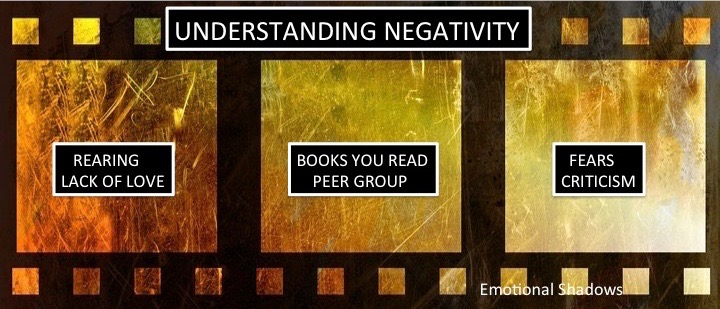
Upbringing plays a major part in forming your thoughts. If people around you lack positivity, have faced too many setbacks in life and are all the time struggling to keep up appearances, you are bound to pick up those vibes. You learn to grapple with the thorns on your path by carrying a tough exterior.

Lack of love in childhood affects emotions in a negative manner. When a child doesn’t get a positive nudge and has to depend on his own feelings, he weaves a protective web around himself. One failure defines his efforts for him, one rejection seems like the end of the road and he learns to blame others. As an adult, his self-defense is negativity.

Negative peoplePeer group exerts significant pressure on us. Social development and true friendships are formed at a young age but rejection; bullying and negative attitude of peer group could hurt your self-esteem. It may lead to the loss of faith in the goodness of humanity. Negative interactions leave a lasting impact on the psyche of those who feel rejected.


What you read, the kind of books you were exposed to builds your perspective. Early impressions tend to stay and you veer toward negative reading – books about ghosts, monsters and villainous creatures become your favorites. You may define life in the same way. You wear a façade of contentment and happiness but could be bitter inside.

Criticism nurtures negativity, as it gives a wrong message to the listener. It is an attack on self-esteem, makes him think he is “no good.” If you were criticized during your developmental years, you tend to grab negativity unknowingly. Negative traits get entrenched in the personality.

Negative emotions too could be beneficial but only if we understand them and are ready to introspect. Read more: How Negative Thoughts Can Be Beneficial For Our Personality.

How do you handle your negative thoughts? Do you know such a person?

If you have liked this post, please share it at your favorite social networks.

Balroop Singh.

Do you think you are a good person? Would you like to meet your better self? Click here to know more.

Raining Opportunities

toys-1903273__340

Rain and clouds – a poet’s delight but they bring in gloom for some. It’s the way we look at things! Perspectives mold us into the kind of individuals we want to be.

Rain brings in some beautiful memories of the distant past, of childhood paper boats and weeping trees, of opportunities to slip out and splash in the transitory pools, which beckoned us to see our delightful faces.

Life passed by, robbing us of those thrilling moments. When the real meaning of opportunities dawned on us, we learned some profound lessons…

Opportunities are like drops of rain…you have to welcome them, harvest them and make them turn around! If you carry an umbrella all the time, you will miss the fun of soaking in their grandeur. They make you the person you would like to be, one day!

If you want to pick up the right opportunity,

  • Have faith in yourself.girl-1438138__340
  • Banish fears.
  • Follow your dreams.
  • Take initiative.

Sometimes opportunities come in the form of blessings, most unexpected but they also come in the form of misfortunes, with hidden possibilities and we may fail to comprehend what they have to offer. Dig deeper!

Mist of circumstances blocks our imagination, stops us from making new beginnings. Sometimes we don’t take the initiative due to lack of support, money, resources, health and sometimes family commitments seem more important. There is a silence within us, which responds only when the opportunity connects with our passion.

Having an open mind toward all the possibilities is the right approach. If we have a positive attitude, half the battle is won. Disappointments may disillusion us but an optimist would call it a blessing in disguise; thinking there is something better waiting for us!

I have always felt horizon is better than the sky because it keeps moving away, hence giving an impetus to our dreams and goals! Let the horizon be your inspiration. Clouds shield the light. Be patient!

“Create the world you want and fill it with the opportunities that matter to you”—Alicia Keys.

What stops you from making new beginnings? Do you have the determination to create your own opportunities? You can share your valuable thoughts here.

If you have liked this post, please share it at your favorite social networks.

Balroop Singh.

Do you think you are a good person? Would you like to meet your better self? Click here to know more.


Expectations Of Writers And Readers

glasses-1246611__340

When a writer puts the first word on paper; a dream world opens before him, a world that ignites his creativity as well as fantasy. Former makes him produce his magnificent work but the latter makes him a celebrity overnight (in his dreams.)

You may be writing out of creative compulsions or the satisfaction of venting your voice could be your trigger, most writers harbor a secret wish – to be read, to be reviewed and admired. Admiration comes easily but you never know how hypocritical it is. Reality hits you when you see how much money you are earning from your books.

You may stay determined with the cliché – “never give up” but when you read others’ work and feel that many average books are overflowing with 5 star reviews; you wonder whether something is wrong with you when you feel like dropping a book that has been fetching 5 stars… (for whatever reasons!)

However, there are critical readers too. They know what they want, their discerning eye can’t be escaped. Their expectations are immeasurable.

You think you have the most original ideas, you would be the best seller but your readers feel you ramble, you repeat and the setting of your story is vague or the title of your book is a misnomer.youtuber-2838945__340

You think you write perfect English, your beta readers are excellent helpers and you have a long list of friends under the acknowledgements but your readers find typos and structural errors in your book.

Each reader expects an amazing book; he doesn’t want to think what were your compulsions or exhaustions. He doesn’t want to buy your excuses. He doesn’t want to digest your lack of finances for hiring an astute editor. All readers are not writers and they have every right to judge your book according to their own parameters. All readers are not kind enough to overlook imperfections in the plot, style of writing or characterization.

Then there are writers who focus on money. They write just what sells. The day writing becomes a chore for you, you are no longer a writer, and you become a businessperson, churning out book after book, devoid of any real emotion.

Your writing may not be “like a windowpane” or “impenetrable fog” but it has to be an “exploration,” it has to “enrich the life of those who read it.” If it is just inconsequential chitchat between a few characters, going around in circles, you may befool a few readers but not all.

Robert Frost’s definition is worth pondering: “The ear is the only true writer and the only true reader. I know people who read without hearing the sentence sounds and they were the fastest readers. Eye readers we call them. They get the meaning by glances. But they are bad readers because they miss the best part of what a good writer puts into his work.”

Are you an “eye reader” or a critical reader? Do you drop a book if you don’t like it? What do you expect from your readers?

Thank you for reading this. Please share your valuable reflections, they are much appreciated.

If you have liked this post, please share it at your favorite social networks.

Balroop Singh.


Book Readers and Reviewers

e-book-1209040__340When digital devices invaded into our lives and living rooms, people thought books would lose their significance. Debates were organized to discuss and create awareness and a new generation of readers cropped up. Smart phones became their books and that was probably the turning point in the habits of readers.

There are three kinds of book readers.

First are those who read just for pleasure or to pass time. They don’t care to write woman-2701154__340reviews, as they take a book like a stranger who passes by. Characters don’t inspire them, as they look at them from imaginative perspective. They don’t dwell on their fictitious troubles, which are dismissed the moment they close the book. They don’t have any TBR list and read whatever they come across. They have a few favorite authors though.

Second are those who read a book just to review it. They are fast readers, may even skip many parts of the book, focusing on the elements that could be useful for their review. Emotions can’t sway them; words don’t move them and nuances of life fail to affect them. They can whiz through pages like a wizard; they can read all genres without a word of dissent. They can read multiple books at a time like a ball juggler. I call them super humans, with magical reading and reviewing skills. I envy them but am glad that I have never tried to be like them.

book-4133988__340 Then there are readers who approach a book like a friend. They fall in the third category. Reading is an experience for them; they connect with characters, feel the emotion of each one, savor the words and highlight what touches them. They are committed readers, in no hurry to finish a book. They choose their books carefully and don’t like to go outside their genre. Their reviews are critically framed, inclusive of good and bad aspects of author’s style and characterization.

Can you connect with one of these readers or are you a combination of all three?

Book reviews speak for themselves whether they have been written by a quick reader or a thoughtful reader; the former would just summarize a book, without going into finer details or saying anything about characters. They don’t care even if their review contains spoilers. I avoid reading any reviews of the book I pick up, as it is a pleasure to tread unknown paths and meet new people from the comfort of my favorite couch.

Do think giving one or two stars to a book is justified?

Recently I have read ‘Where We Belong’ by Emily Giffin and really liked it. But some reviewers have called it “the most appalling book”. This book has such varied reviews…from one star to five stars! I am astounded by the uncivilized language some of the readers have used while reviewing this book, which deals with emotions and relationships brilliantly.

Reviews acquaint us with our imperfections, if they are honest. They also provide a learning opportunity. I like a bad review too; if it is constructive and offers an in-depth analysis into writing. A good review is like a fragrant breeze that wafts around me for many days, boosting my creative juices.

Thank you for reading this. Please share your valuable reflections, they are much appreciated.

If you have liked this post, please share it at your favorite social networks.

Balroop Singh.